Explore a different destination  UNESCO World Heritage Site  Angkor Thom, Capital of Jayavarman VII


    Monuments of Angkor Cambodia Asia Travel Guide Earth World Greatest Sites    Advertise on this page  Bookmark and Share  AsiaExplorers on Twitter
The sight is located within Angkor. To prepare for your visit, read the AsiaExplorers Angkor Travel Guide for useful information. Visitors to Angkor stay at the town of Siem Reap. If you are looking for budget accommodation in Siem Reap, use the Cambodia Budget Accommodation Guide to find a place to stay.


Late 12th Century (circa 1181AD)
by King Jayavarman VII


Angkor Thom means
"Great City"

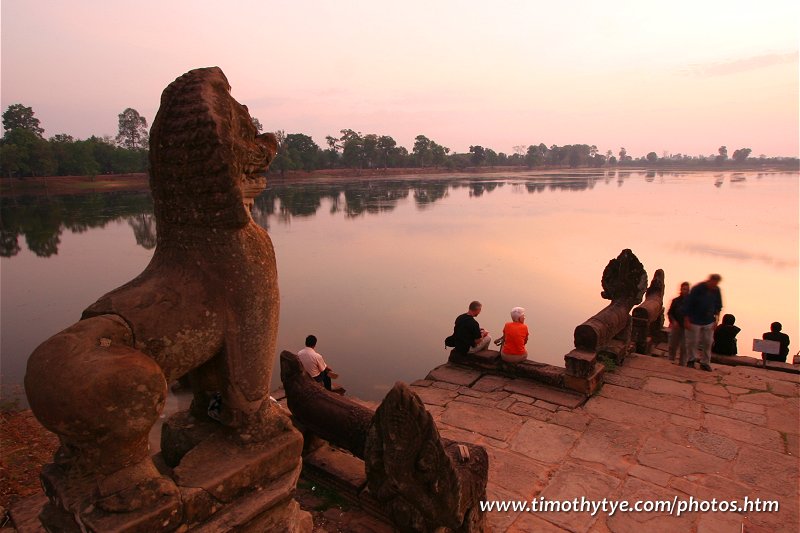
Angkor Thom, the capital of Jayavarman VII, the greatest ancient Khmer king, is an ancient Khmer city just north of Angkor Wat. The dimensions of Angkor Thom is simply mind boggling. It is a square piece of walled up area measuring a massive 360 acres (9 sq km!) and surrounded by a gigantic moat. Each side of Angkor Thom is three kilometres long. The moat surrounding the outer wall is 100 metres wide. But what makes the first sight of Angkor Thom so awesome are the causeways.

There are five entrances into Angkor Thom, four in each cardinal direction, north, south, east and west, while the fifth, called the Victory Gate, leads eastwards from the Angkor Thom Royal Palace grounds. Each of these used to have a causeway leading towards it, but today only the south gate has water under it.

I was privileged to visit all the five gateways into Angkor Thom. If you are coming from Angkor Wat, your first sight of Angkor Thom will be the South Gate. It's the one closest to Siem Reap. The gate consists of a stone causeway that leads to a huge archway.


Angkor Thom Causeway, with the South Gopura in front


Angkor Thom Demons, in a scene from Churning the Ocean of Milk


The causeway is lined with stone figures. Count them. There are 54 stone Devas, or gods, on the left, and 54 stone Asuras, or demons, on the right. They are tugging on a naga. This awesome spectacle is a stone representation of the ancient Hindu creation myth, Churning of the Ocean of Milk, which is also depicted in Angkor Wat, while a very modern version is also seen in the Bangkok Suvarnabhumi Airport. I have to say that the Khmer versions at Angkor Wat and Angkor Thom are way more spectacular than that at Suvarnabhumi.

Which are the gods and which the demons? The gods have almond-shaped eyes, while the demons are grimacing and wearing conical helmets. If you observe them carefully, you will notice that they are pulling something. That something is a huge snake, or naga, with nine heads opened up like a fan.

The causeway takes you to a huge archway, called a gopura. It towers 23 metres (75 feet) high, and crowned with four massive stone faces, each facing a cardinal direction. At the base, on both sides of the gate are stone three-headed elephants. Their trunks are plucking lotus flowers - as though from the moat itself. The elephant is Erawan, also called Airavata in Khmer. It is a motif that you would come across repeatedly in Khmer and Thai religious designs. The Hindu god Indra sits at the centre of the elephant with his wives, each on each side.

As you walked though that huge archway, you are entering Angkor Thom, the city of King Jayavarman VII. Although many other Khmer kings built within Angkor Thom, it was Jayavarman VII who created it, around 1181, after he defeated the Cham kingdom. Jayavarman VII is recognised as the most prolific builder in Angkor history. Many of the temples in Angkor were built by him, but not Angkor Wat.


Angkor Thom is located to the northwest of Angkor Wat. By area, Angkor Thom is bigger than Angkor Wat; the difference is Angkor Thom consists of a collection of ancient ruins whereas Angkor Wat is one single massive building. Angkor Thom includes many temples, terraces, as well as the royal palace - of which what remains are the walls and the royal ponds - all within a perfectly square area, bounded by high walls, and punctuated by the five entrance gateways, called Gopuras. It is indeed, as its name imply, a great ancient city.

At the time that Angkor Thom was built, it was grander than any city in Europe. According to historians, Angkor Thom must have supported a population exceeding one million, making it bigger than the total population of London and Paris combined, at its time.

There is so much still to describe of Angkor Thom and the ruins within in, so I shall break them into different pages. From here, you can visit the different gates simply by clicking on the thumbnails listed below.

Click thumbnail to visit the Gateways into Angkor Thom.

South Gate

Victory Gate

North Gate

East Gate

West Gate


There are many ruins within Angkor Thom. I have visited the majority of them, and listed them here, so that you can explore from the convenience of your desktop.

Click thumbnail to visit the various ruins within Angkor Thom.

Baphuon

Bayon

East Pond of Royal Palace

Large Pond of Royal Palace

Mangalartha

North Khleang

Phimeanakas

Prasat Suor Prat

Preah Palilay

Preah Pithu

Royal Palace of Angkor Thom

South Khleang

Tep Pranam

Terrace of the Elephants

Terrace of the Leper King


Return to Angkor World Heritage Site Main Page


How to go to Angkor Thom

Angkor Thom is one big area within which are many more significant temple ruins. The three main directions that you can enter Angkor Thom is from the south, east and north. The main entrance to Angkor Thom is its South Gate, located 1.7km north of the main entrance to Angkor Wat. The eastern approach to Angkor Thom is via the Victory Gate (the East Gate appears to reach a dead end, in comparison). The Victory Gate is 1km west of Ta Keo. From the north, Angkor Thom is 1.6km from Preah Khan.

Return to Angkor Travel Guide or to Cambodia Travel Guide

Compare Hotel Room Rates

Find the lowest price of hotel rooms from different Hotel Booking websites. Our free Hotel Search Engine lets you compare room rates from different booking sites. Just key in your visiting City. You'd be glad to do your homework!


Find Local Tours in Cambodia

As an independent traveler, you have the freedom to create your itinerary according to your own schedule. Here are local tours of Cambodia that you can fit into your vacation.

Follow me on Twitter

Sign up to Tim's Travel Tips, and let me take you to explore the places in Asia.

Please link to me!

If you enjoy exploring Asia and getting to know its places of interest, place a link from your website or blog to AsiaExplorers. Let AsiaExplorers be your window to all the fascinating sights in Asia! It is as easy as copying the source code below and pasting it on your site:
Return to AsiaExplorers homepage

View Updates from my other sites: Earth Documentary, Flowering Garden, Penang Travel Tips and World Greatest Sites


Copyright © 2003-2010 AsiaExplorers.  All rights reserved.

AsiaExplorers is researched and written by Timothy Tye. Reasonable care is taken to check and verify the accuracy of the content. AsiaExplorers disclaims responsibility for any inconvenience, mishap, injury or death resulting from following the tips and advice provided directly or indirectly by this website. All pages may be printed out for your own personal, non-commercial use. Photographs not credited to a third party belong to Timothy Tye and may not be reused in any form unless you are first given permission. Write in to inquire if interested. Third party photographs are governed by their respective licenses. The author is a Christian. Click here if you are interested to know more about his Christian beliefs. To contact AsiaExplorers, use the following email address: