The sight is located within Angkor. To prepare for your visit, read the AsiaExplorers Angkor Travel Guide for useful information. Visitors to Angkor stay at the town of Siem Reap. If you are looking for budget accommodation in Siem Reap, use the Cambodia Budget Accommodation Guide to find a place to stay.
Built towards the middle of the 12th century
Banteay Samre is a medium-size ruin located on the east side of Angkor, away from the rest of the monuments. Visitors usually combined an excursion here to a visit to Banteay Srei. However, as I discovered, although Banteay Samre is on the way to Banteay Srei, it isn't that far out, so I visited it together with the ruins of the Small Circuit, such as Ta Prohm, Thommanon, etc. I know this is not the usual practise, but it works for me. As for Banteay Srei, I visited it combined with Kbal Spean.
The inner enclosure of Banteay Samre, as seen from the outer wall.
Banteay Samre is named after a people called Samre who lived at the foot of Mount Kulen. The people living in the village of Pradak (which you'd pass on your way to Banteay Samre) are said to be their descendents.
There is a story associated with Banteay Samre. In this story, there was a poor farmer named Pou. He planted sweet cucumbers from seeds he received through some supernatural way. When he got his first harvest, he presented it to the king, who found it so sweet that he wanted it all for himself. He commanded Pou to kill anybody who enters the cucumber field.
One night during the rainy season, the cucumbers were scarce. The king, rather impatient to taste it, sneeked into the cucumber field himself. Pou, not realising it was the king, mortally wounded him with his lance, and buried the "thief" in the field.
The king had no direct descendants, so his noblemen resorted to divine intervention. They sent out his white elephant. The elephant stopped in front of the Pou, and paid homage him him by lowering his trucnk between its feet and knelt. The noblemen took this as a sign, and enthroned Pou as king.
On becoming king, Pou exhumed the corpse of his predecessor and gave it a funeral ceremony at the East Mebon, followed by the rites of cremation at Pre Rup.
The new king, however, was facing difficulties in controlling his court dignitaries. Feeling humiliated at being governed by a lowly farmer, they expressed their discontent by refusing to show respect to him. Pou, feeling powerless to discipline them, left the Royal Palace and went to live in solitude at Banteay Samre. There, King Pou issue a decree to have all those who humiliated him beheaded. After that incident, his reign continued peacefully.
When Banteay Samre was discovered, it was overrun with vegetation. Restorers using anastylosis - a restoration process of dismantling, reassembling and replacing vital lost pieces - has brought out the beauty of Banteay Samre. When I visited it with Chooi Yoke, we found that the temple was very well kept. The lawns were neat and tidy, and there were workers upkeeping the place.
I learned that Banteay Samre was restored after a similar project was carried out on the much smaller (but perhaps even more exquisite) Banteay Srei. The knowledge and experience gained from the Banteay Srei project provided restorers the confidence to execute the task.
No inscription was found on Banteay Samre to accurately pinpoint its construction date. Nevertheless, judging from the style of its construction, Banteay Samre is believed to have been built around the time of Angkor Wat, that is, towards the middle of the 12th century.
Banteay Samre consists of an outer wall with four gopuras enclosing a courtyard. Raised within the courtyard is the second enclosure. There is an east and a west inner gopura that links to the gopuras of the outer wall. Steps lead steeply from the outer wall to the central courtyard. There is an seconde courtyard within the second enclosure. Detached within this inner courtyard are two structures which restorers called the "Libraries". And then, right in the middle of the whole complex, is the Central Sanctuary. I think trying to explain in words sounds rather confusing. When I have the time, I shall draw a plan so AsiaExplorers members can understand me better.
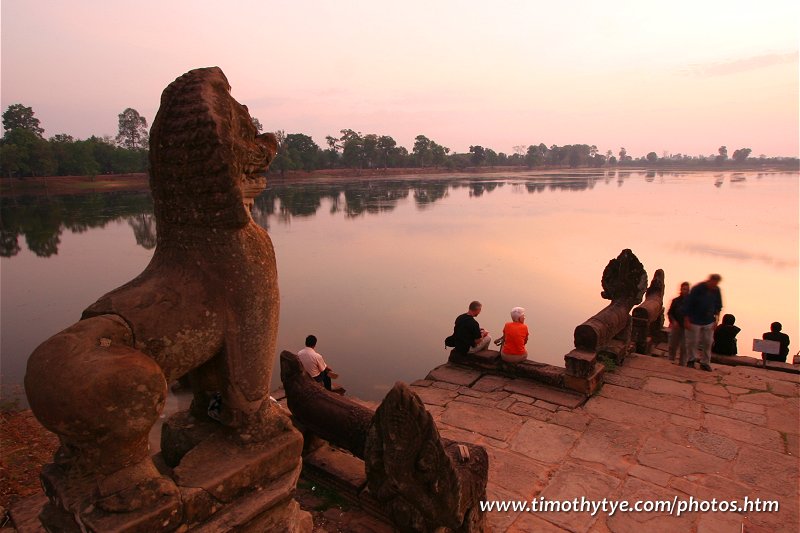
I arrived at Banteay Samre with Chooi Yoke quite early in the morning, by tuk tuk driven by Mr Han (see contact below). The road took me to the northern side of the monument. From there, we walked to the main entrance to the east. At the east is a 200 metre causeway with naga balustrades and stone lions at regular intervals. I walked the whole length of the causeway to have a feel of its size. The pools on both sides of it have long gone.
After causeway, we entered the outer enclosure. I walked around to get a proper angle. It was still early morning and the sun had jus risen, bathing the monument in a rich vermillion. I observed that the north, west and south gopuras are of similar design. They are cruciform in plan, and have two wings connected to the galleries as well as two porticoed doors.
As I walked around Banteay Samre, it appears so similar to Angkor Wat, but only at a reduced scale. Even the prasats, or towers, are similar to those at Angkor Wat, and if I may add, those at Banteay Samre appear in a better degree of preservation.
The tympanums on the porticoes are often ornately sculptured. I learn that the best preserved panel, also one of the finest in Khmer art, is found on the north gopura northern side. (I must say I didn't see it, as it was against the light at the time of my visit). Drawn from the Ramayana epic, it depicted the fight between Rama and Ravana, each on their respective chariots.
Banteay Samre is not the most popular monument in Angkor, which is a shame because it is an exquisite example of Khmer art. Owning perhaps to its distance, not many people have been to it. Nevertheless, I would encourage AsiaExplorers members who have read my description here to attempt visiting it should they be Angkor.
One of the gopuras, or towers, at Banteay Samre.
Traces of a causeway that extends from the east entrance of Banteay Samre. style.
Guardian lions on the causeway, with the central sanctuary of Banteay Samre in the background.
Morning sun lit up the eastern side of Banteay Samre.
A lingga with yoni within Banteay Samre.
How to go to Banteay Samre
To get to Banteay Samre, turn right somewhere between Pre Rup and East Mebon, about 14km from Siem Reap. (I think there is a signpost - if you're passing that way, can you verify for me?) After that, go straight on the road between Pre Rup and the eastern Mebon. The road will pass a small Cambodian village (the name of the village is Pradak). Here, you see a T-junction to the left. The left turn takes you to Banteay Srei. Don't turn left, but continue straight on for another 2 km or so, and you arrive at a right run dirt road. This road takes you to the northern entrance of Banteay Samre.
If you need tuk tuk, you can call my tuk tuk driver Mr Han (contact below) to see if he is available to take you there.
Angkor, Unesco World Heritage Site
AsiaExplorers provides you one of the most detailed documentation on Angkor, Unesco World Heritage Site, for you to explore from the comfort of your desktop.
Siem Reap Travel Guide
If you are visiting Angkor, it's almost definite that you will be staying in a hotel or guesthouse in Siem Reap. You will probably also need to hire a tuk tuk to take you around. Click the thumbnail on the left to view vital details to make your stay in Siem Reap more pleasant.
Before booking a hotel room, make sure you are getting the lowest price for it. Different hotel booking websites offers the same room at different prices. If you stick with one site all the time, you could be paying more for the same room. Now why pay more?
The form below is a Research Engine. It doesn't take bookings. Instead it lets you find the hotel booking website that offers the room you want at the lowest price. You can see and compare what different sites are offering, and then click to choose the one with the best price. Do this, and you're guaranteed to save a whole lot of money on your room reservations!
If you're flying somewhere, use our Flight Checker to compare the rates from different airlines. To use it, enter where you will be flying from, where you will be flying to, your departure date and return date. Select the number of passengers, and then click search.
Our engine will return you a list of possible flights that you can take. You can compare the fare of different airlines for your trip. Click on your selected airline, and we transfer you to the airline website.
AsiaExplorers is researched and written by Timothy Tye. Reasonable care is taken to check and verify the accuracy of the content. AsiaExplorers disclaims responsibility for any inconvenience, mishap, injury or death resulting from following the tips and advice provided directly or indirectly by this website. All pages may be printed out for your own personal, non-commercial use. You may use the information on this website on your blog or website so long as you place a dofollow link back to the page in AsiaExplorers where it appears. Photographs not credited to a third party belong to Timothy Tye and may not be reused in any form unless you are first given permission. Write in to inquire if interested. Third party photographs are governed by their respective licenses. To contact Tim, write to the following email address: