Bayon
Temple of Stone Faces, Angkor


The sight is located within Angkor. To prepare for your visit, read the AsiaExplorers Angkor Travel Guide for useful information. Visitors to Angkor stay at the town of Siem Reap. If you are looking for budget accommodation in Siem Reap, use the Cambodia Budget Accommodation Guide to find a place to stay.

Built in the late 12 - Early 13th Century,
by King Jayavarman VII (reigned 1181-1220)


Bayon is the second most popular ruin in Angkor after Angkor Wat. This is the temple of stone faces. Located right in the middle of Angkor Thom, the Bayon is the favourite temple ruin of many. To me, it is simply the most extraordinary. In fact, it is so spectacularly unique in style that it even eclipses Angkor Wat as its most recognised icon of classic Khmer art and architecture.


The enigmatic Bayon, seen from afar, becomes a metaphorical stone mountain.


The Bayon was one of the last major temples to be erected. Like many of the ruins in Angkor Thom, it was erected by the ever prolific King Jayavarman VII. Anybody seeing the Bayon for the first time would be awed. From far, it looked like a stone mountain. And in fact, that's what it was intended to represent, Mount Meru at the centre of the Hindu/Buddhist cosmos. But as you come closer and closer to it, something bewildering happens. The stone mountain starts to transform, and right before your eyes, they become a mountain of stone faces.

You would have been introduced to those stone faces when you entered Angkor Thom right any of the massive gateways. But now those very stone faces are piled together in what appears to be an assorted jumble. Faces peered at you from all corners. Lips as puffy as Tina Turner's smiled at you.

I have visited the Bayon a few times, and I am still awed by the effect. I learned that the temple consists of 57 standing towers spotting a forest of stone faces. People have calculated that there are all together over 200 faces towering over the Bayon. They represent either the Avalokiteshvara or a combination of Buddha and Jayavarman VII (two schools of thoughts exist on this, so I won't join in the frey). Whoever they represent, to me they are the most enigmatic icon of Angkor ruins.


The recommended way to explore the Bayon is to start from the main entrance located on the east side. There are entrances at all four cardinal directions, but the best carvings are those closest to the main entrance, and according to anti-clockwise route around the temple. As you go around the temple, you will be introduced to the many bas-reliefs that cover its walls. Unlike those in Angkor Wat that show grand processions, many of the reliefs at the Bayon are very much down to earth. They depict everyday life during the ancient times, specifically the time around the late 12th Century. And what do you know, much of the activities way back then is still common in rural Cambodia today.

So you have on the walls scene of market place, of people buying and selling, of cock fighting, cooks preparing for a banquet, a chess game, what a kaleidoscope of activities. I will revisit these walls and document them more fully another day.

No matter how organised you intended your visit to the Bayon to be, as soon as you entered the ground level, you're in a tight maze of narrow passageways. Some are blocked by fallen walls and ceilings. So it is not possible to explore every bit of the Bayon systematically, without coming upon roadblocks, so to speak.

After you are done with the lower level, climb the very steep stone staircase to the upper floor. In doing so, you free yourself from the jumbled world below. Upstairs is open, spacious, and it's here that you come face to face with the stone faces. As you examined them, you realised that they have been pieced together, block by block. So they're not all of one piece, but fit together like a massive stone jigsaw puzzle.

A visit to the Bayon is always one of the highlights of any Angkor trip. You should give yourself at least an hour to fully appreciate this awesome ruin. See it to your heart's content, and be satisfied that you have fully explored the Bayon.


The Bayon appears like a stone mountain from afar.


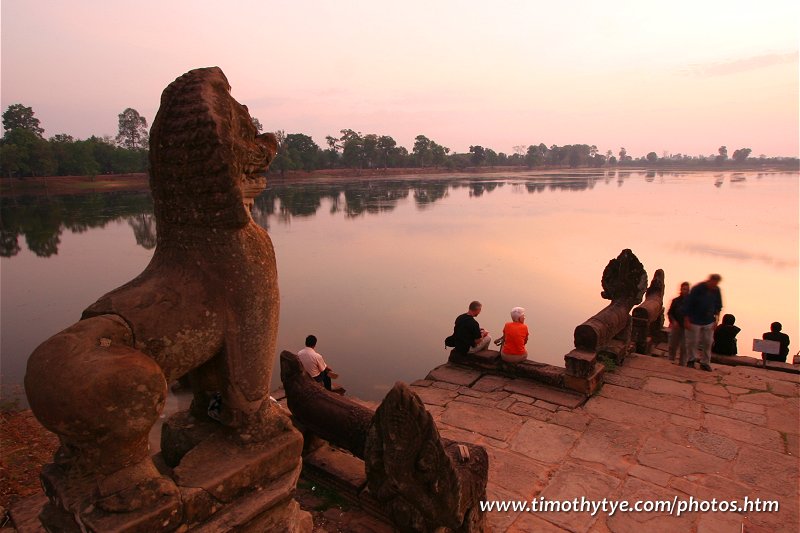
A stone guardian lion in front of the causeway leading towards the main entrance of the Bayon.


A pair of stone lions on the Bayon causeway.


A jumble of stones characterises the ground level at the Bayon.


A yoni stone in one of the lower chambers of the Bayon, with its accompanying lingga missing.


Due to the haphazard way the corridors and passageways are arranged, I was able to take this shot seemingly from the ceiling of this corridor.


Even the dark corridors are ornately carved.


One of the many enigmatic stone face.


A stone face smiles at latter day explorers.


Tim with one of the stone faces.


How to go to the Bayon

The Bayon is located right at the centre of the ancient Khmer city of Angkor Thom, with roads leading north and south as well as smaller lanes leading towards the east and west. Most first time visitors will arrive from the direction of Angkor Wat. They will approach Angkor Thom and pass through its South Gate. The Bayon is just 1.5 km after the gate.

If you have the time to spare, the best way to explore the Bayon is by hiring a tuk tuk for the day.


Angkor, Unesco World Heritage Site

Exploring Angkor, Unesco World Heritage Site

AsiaExplorers provides you one of the most detailed documentation on Angkor, Unesco World Heritage Site, for you to explore from the comfort of your desktop.

Angkor, Unesco World Heritage Site


Siem Reap

Siem Reap Travel Guide

If you are visiting Angkor, it's almost definite that you will be staying in a hotel or guesthouse in Siem Reap. You will probably also need to hire a tuk tuk to take you around. Click the thumbnail on the left to view vital details to make your stay in Siem Reap more pleasant.

Siem Reap Travel Guide


Expedia.com


Copyright © 2003-2008 AsiaExplorers.  All rights reserved.

About the Author: AsiaExplorers is researched and written by Timothy Tye. We take reasonable care to check and verify the accuracy of the content. However, we disclaim any responsibility for any inconvenience, mishap, injury or death resulting from following the advice provided directly or indirectly by AsiaExplorers and the comments on its pages. All the photographs in AsiaExplorers are available for publication. Please contact AsiaExplorers at the following email address for your enquiries: