Phnom Bakheng
Angkor Mountain Temple, Ruins of Ancient Angkor, Cambodia
The sight is located within Angkor. To prepare for your visit, read the AsiaExplorers Angkor Travel Guide for useful information. Visitors to Angkor stay at the town of Siem Reap. If you are looking for budget accommodation in Siem Reap, use the Cambodia Budget Accommodation Guide to find a place to stay.
Built in the late 9th to early 10th Century
by King Yasovarman I (reigned 889-910)
Phnom Bakheng is a temple built on a hill of the same name, where the first city at Angkor was established. This gives its state temple on Phnom Bakheng special significance. It was to here that Yasovarman I moved his capital from Roluos. His capital city, called Yasodharapura, was larger than Angkor Thom, which came later, and was centred around the hill of Phnom Bakheng.
The design of the temple of Bakheng borrowed elements from the Bakong which was built 20 years earlier. Both are step pyramids of ascending square terraces. We do know that work on the temple began at the end of the 9th century. The lingga in the central sanctuary was dedicated around 907AD, while construction work continued. The temple was called Yasodharesvara, after its patron deity, which means Lord who Bears Glory. In 928 the temple was abandoned, only to be briefly rehabilitated in 968 by Jayavarman V.
An exposed lingga at the temple of Phnom Bakheng
I visited Phnom Bakheng with my wife on the late part of the morning, when the sun was beginning to warm up the day. As I have visited before using the short but steep way, this time around, I decided to use the elephant trail, which is longer but less steep. This allows for a more leisurely climb up the hill.
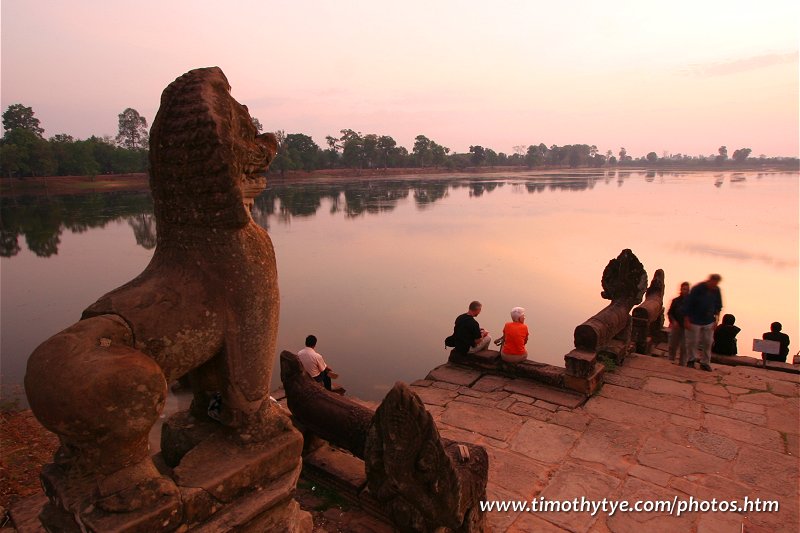
When the temple was built, there used to be an outer enclosure that surrounded the hill. There were four gopuras at the cardinal points at the foot of the hill. Today only their foundation can be traced. Stairways lead up from the east, north and west gopuras, but not the south, probably because (as with most Angkor temples) the work was never fully completed. The east entrance was the main one, and here, one can still see the pair of guardian lions.
The pyramid temple is 13 meters high, consisting of five terraces. The pyramid is not exactly centered, but set slightly to the west. At the base of the pyramid are 44 brick towers set in groups of 2, 3 and 4 each. On the terraces are another 60 small towers, with pairs flanking the stairway. On the summit are another five towers each 1.6m high and set back slightly to the west. In total, there are 108 towers, corresponding to a sacred number in Hinduism and Buddhism.
How to go to Phnom Bakheng
Phnom Bakheng is located 1.2km north of the west entrance of Angkor Wat. From Siem Reap you should take the road to Angkor Wat, and then continued on till you arrive at Phnom Bakheng, which is on the left side of the road. The climb up to Phnom Bakheng is quite tiring, depending on your own level of fitness. If you're like me, with a heavy load of camera gear in tow, then I would suggest following the elephant trail. It is a more leisurely climb than less steep than the straight route. Some times elephant service is also available at about US$10 per ride.
Most tuk tuk drivers would be able to take you to Phnom Bakheng. Also, you can contact my tuk tuk driver, Mr Han (see contact below) to see if he is available to take you.
Arriving at Phnom Bakheng.
Statue of Nandi, the sacred ox, facing the ruins of Phnom Bakheng.
Libraries at Phnom Bakheng.
Steep steps up Phnom Bakheng.
My wife Chooi Yoke standing beside the small towers flanking Phnom Bakhang stairs.
Summit of Phnom Bakheng.
Exploring Angkor, Unesco World Heritage Site
AsiaExplorers provides you one of the most detailed documentation on Angkor, Unesco World Heritage Site, for you to explore from the comfort of your desktop.
Siem Reap Travel Guide
If you are visiting Angkor, it's almost definite that you will be staying in a hotel or guesthouse in Siem Reap. You will probably also need to hire a tuk tuk to take you around. Click the thumbnail on the left to view vital details to make your stay in Siem Reap more pleasant.
About the Author: AsiaExplorers is researched and written by Timothy Tye. We take reasonable care to check and verify the accuracy of the content. However, we disclaim any responsibility for any inconvenience, mishap, injury or death resulting from following the advice provided directly or indirectly by AsiaExplorers and the comments on its pages. All the photographs in AsiaExplorers are available for publication. Please contact AsiaExplorers at the following email address for your enquiries: