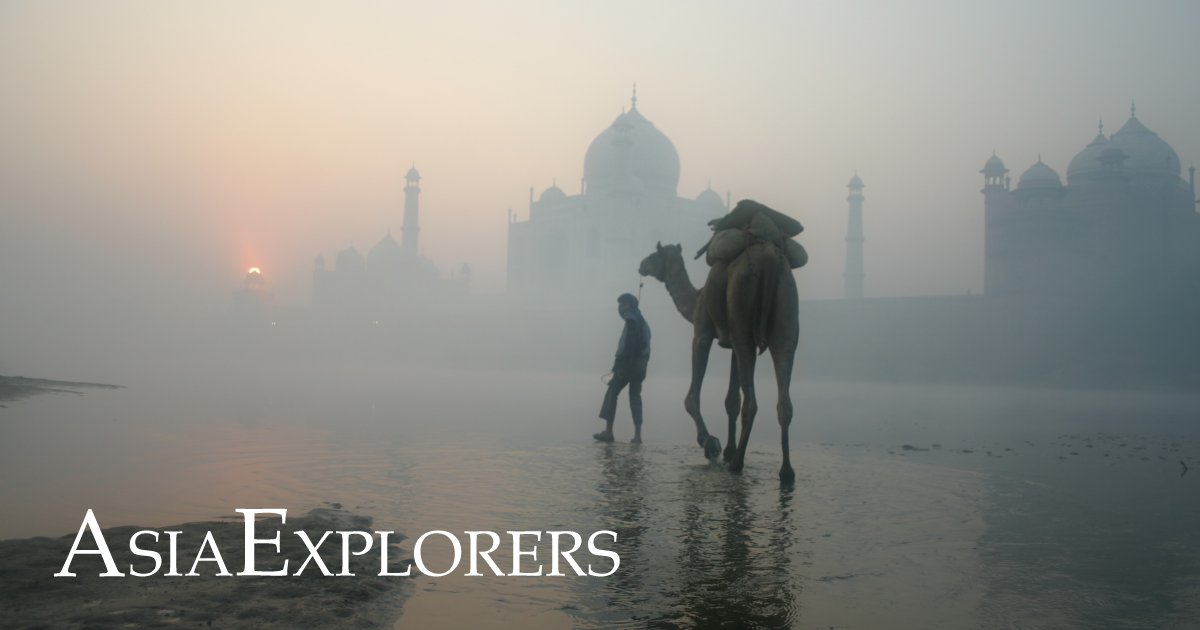
This sight is located in Agra, India. For travel information about Agra, read the Agra Travel Guide. To prepare for a trip to India, read also the India Travel Guide. Looking for budget accommodation? Use AsiaExplorers Budget Accommodation Guide, the no-frills website to cover your budget accommodation needs.
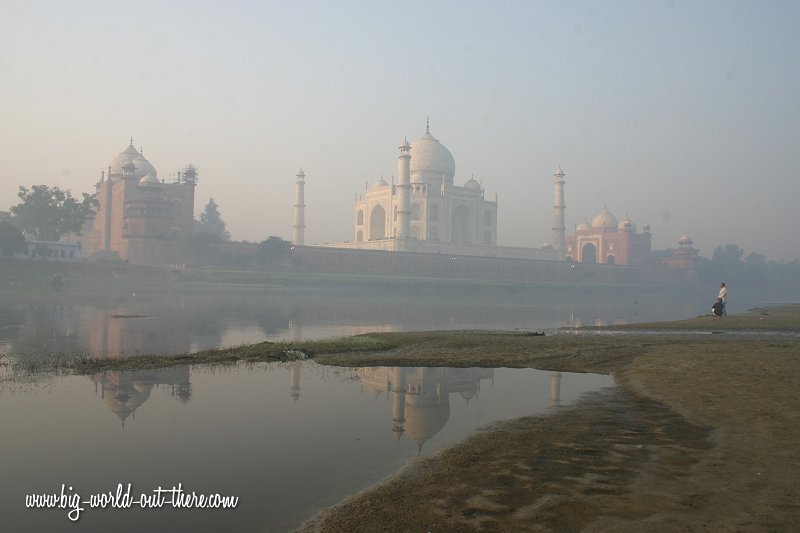
Agra Fort is a great monument of red sandstone dominating a bend in the river Yamuna, 2km northwest of the Taj Mahal. I took this photograph from the chamber overlooking the Yamuna River. The Taj Mahal is just a short distance away. Unfortunately the atmospheric haze on that day was so bad that we could only see the Taj faintly in the distance. This photo is taken near the chamber where Emperor Shah Jahan was kept in house arrest by his own son.
Agra Fort was constructed by the Mughals during 1565-1571. Emperor Akbar laid its foundation in 1565. The fort is crescent shaped, flattened on the east with a long, nearly straight wall facing the river. Its colossal double walls rise 69 ft in height and measure 2.5 km in circumference encircled by a moat and contain a maze of buildings which form a small city within a city. Two generations of creative builders worked on the structures within the fort during the time of Akbar and later Jehangir and Shahjahan.
There are 2 gates into Agra Fort, the Delhi Gate and the Amar Singh Gate. The original and grandest entrance was Delhi Gate, which leads to the inner portal called the Hathi Pol or Elephant Gate. But now the entrance to the fort is only through the Amar Singh Gate.
Public access is limited to the southern part of the fort which includes nearly all the buildings of tourist interest, listed below:
View of Jahangiri Mahal in Agra Fort.
Diwan-i-Khas
The hall of private audience. This was also added by Shah Jahan. This hall is divided into two rooms connected by three arches and it was here that the famous peacock throne was kept before being shifted to Delhi by Aurangzeb and finally carried away to Iran.
Diwan-i-Aam
This structure was originally made out of wood but was later constructed in the present form by Shah Jahan. The throne room bears a clear influence of Shah Jahan style with the inlaid carvings and panels of marble with floral motifs. This hall of public hearing is the place where the Emperor heard the petitions of the public and met the officials. The hall of public hearing gives way to the Nagina Mosque and the Ladies bazar where only ladies merchants were allowed to sell items to the Mughal ladies.
Musamman Burj, the Octagonal Tower
This exquisitely carved tower is close to the Diwan-i- Khas. It was here that Shah Jahan spent last seven years of his life imprisoned by his son Aurangzeb. The tower was considered to provide one of the best views of the Taj but today the pollution has reduced the visibility. The tower is in bad shape today but blank spaces and the empty inlay works give an idea how this building must have looked in those days.
Mina Masjid
Just above the Sheesh Mahal is situated the Mina Masjid, which is believed to be constructed by Shahjahan for strictly private use. The Mina Masjid is enclosed on all the four sides by high walls. The marble mosque has three small arches in its facade, which are plain and unadorned.
Jehangir Palace (Jahangiri Mahal)
This was built by Akbar for his favorite son Jehangir to provide him with the comfort and luxury inside the fort.
Machhi Bhawan
Opposite to the Diwan-E-Khas is the machhi bhawan, the fish enclosure. The emperor sat on the white marble platform facing the enclosure. It once contained pools and marble fountains, which were carried off by the Jat Raja Suraj Mal to his palace at Deeg.
Agra Fort Photo Gallery
Approaching Agra Fort is like approaching Ayers Rock, it's a huge monolith in front of you.
(left)
Despite its stout walls and bastions, Agra Fort is really the palatial living quarters for Mughal emperors.
(right) In the middle of the courtyard is a giant bowl. It was where the emperor took his bath as a baby.
(left) Arabesque designs on the walls of the imperial living quarters.
Corridors of symmetry supported by colonnaded arches.
(left) and (above)
The Nagina Masjid, a private mosque for use by the ladies of the harem.
It was built by Shah Jahan entirely of white marble - similar to the Taj Mahal.
(left) The Jahangiri Mahal, built by Akbar for his son Jahangir, is the only major palace in the fort that dates to Akbar's reign.
Bird in a Gilded Cage. - This is the Musamman Burj, the imperial suite where Emperor Shah Jahan stayed in house arrest after he was disposed by his own son. It affords a splendid view of the Yamuna River, all the way to the Taj Mahal, to which his gazed and spent the balance of his life.
About the Author: AsiaExplorers is researched and written by Timothy Tye. We take reasonable care to check and verify the accuracy of the content. However, we disclaim any responsibility for any inconvenience, mishap, injury or death resulting from following the advice provided directly or indirectly by AsiaExplorers and the comments on its pages. All the photographs in AsiaExplorers are available for publication. Please contact AsiaExplorers at the following email address for your enquiries: