Bhubaneswar Travel Guide, India
 Bhubaneswar, India Author: G.-U. Tolkiehn (Creative Commons Attribution ShareAlike 3.0)
Bhubaneswar is the capital and largest city in the Indian state of Odisha, in eastern India. It has a very long history that goes back over 3,000 years, and has long been an economic and religious center. The city was the capital of the ancient Kalinga kingdom which flourished around 265 BC.
Guide to Bhubaneswar Hotels
It's never easy finding the hotel that's just right for your stay. Still, by taking a little time to do your research, you increase your chance of getting a good hotel at the best price. Go through the list of hotels in Bhubaneswar which we've put together, with full description, star rating, address, location map and evaluation. Pick the hotel of your choice and view the rates offered by different booking sites. Yes, we show you prices from different websites, so you don't have to visit them one by one.
 Lingaraj Temple, Bhubaneswar Author: G.-U. Tolkiehn (Creative Commons Attribution ShareAlike 2.5 Generic)
More on Bhubaneswar
The present-day Bhubaneswar metropolitan area comprises Bhubaneswar and Cuttack, which was the capital of the state of Odisha until 1948. Together, the area has a population of about 1.7 million people.
Bhubaneswar is often called the Temple City of India due to the numerous temples found there. These temples, number some 600 in total, span the entire history of the Kalinga architecture. Today's visitors can visit some of these temples.
Bhubaneswar enjoys a tropical climate. The temperature ranges from a low of 15°C in the months of December and January to a high of 38°C in May. Rainfall is highest in the months of July and August, at over 320 mm for each of these months, and lowest between November to April, at less than 40 mm each.
Budget Travel to Bhubaneswar
You can fly to Bhubaneswar from most of the major cities in India including New Delhi, Kolkata and Mumbai.
Budget Travel within Bhubaneswar
The easiest way to go about in Bhubaneswar is to take the auto-rickshaws. You should negotiate a fee with the driver beforehand. If you are going to use him for the whole day, it is also a good idea to negotiate for a full-day fare.
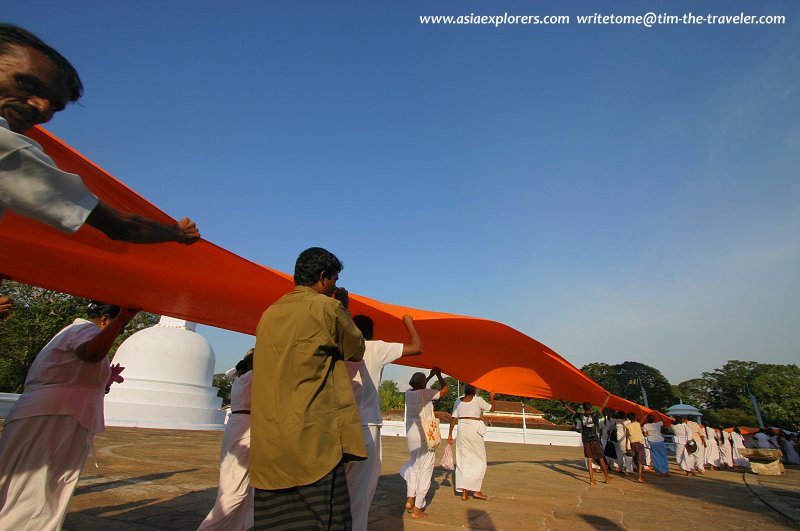
 Dhauligiri Stupa, Bhubaneswar Author: Vishnu Sharma (Creative Commons Attribution 2.0 Generic)
|
Places of Interest in Bhubaneswar
- Lingaraj Temple
A magnificent 11th century temple that marks the pinnacle of the Orissan architectural style.
- Bindusagar Tank
Manmade waterlank believed to contain water from every sacred river in India.
- Vaital Deul Temple
8th century temple to the west of Bindusagar Tank, with gruesome interior carvings.
- Parasurameshwar Temple
7th century temple with the most lavish sculptures from its period.
- Mukteshwar Temple
10th century temple with exquisite sculptures, regarded as the jewel of Orissan temple architecture.
- Rajarani Temple
11th century temple with a spire decorated with miniature replicas of itself.
- Orissa State Museum
Museum with a rich collection of Buddhist and Jain artifacts, along with coins and ancient manuscripts.
Places around Bhubaneswar
- Nandan Kanan Zoo
The place to view the rare Bengal white tigers.
- Udaigiri and Khandagiri Caves
Caves turned into retreats for Jain monks in the 1st century BC.
- Rani Gumpha (Queen's Cave)
The most impressive cave of Udaigiri.
- Chhota Hathi Gumpha (Small Elephant Cave)
Cave in Udaigiri with six elephants flanking the entrance.
- Ganesh Gumpha
Cave in Udaigiri with intriguing battle scenes.
- Bagh Gumpha (Tiger Cave)
Cave in Udaigiri which has the shape of a tiger's head.
- Hathi Gumpha (Elephant Cave)
The most historic cave in Udaigiri, with inscription from the 1st century BC.
- Ananta Cave
Cave in Khandagiri with carvings of twin serpents on the arches over its doorway.
- Dhauligiri
White Buddhist stupa 8km to the south of Bhubaneswar.
- Chausath Yogini Temple
9th century circular temple dedicated to the 64 manifestations of the goddess Shakti.
- Pipli
Village 15 km south of Bhubaneswar, famous for its appliqué-work fabrics, originally used in the temples for covering the deities.
|
|