Mughal Gardens
Eden of the Maharajahs, Srinagar, Kashmir


This sight is located in Srinagar, India. For travel information about Srinagar, read the Srinagar Travel Guide and Kashmir Travel Guide. To prepare for a trip to India, read also the India Travel Guide. Looking for budget accommodation there? Use AsiaExplorers Budget Accommodation Guide, the no-frills website to cover your budget accommodation needs.

The Mughal Gardens of Srinagar are a legacy left behind by the Mughal emperors who were captivated by the beauty of Kashmir, and visited Srinagar as often as they could.
Kashmir offered a refreshing getaway from the heat and dust of Agra and Delhi. In this heavenly retreat, the Mughal rulers planted many exquisite gardens with stepped terraces and flowing watercourses, to create a metaphorical eden. There were once dozens of gardens but today only three remain from the time of the Mughal empire. They are Cheshma Shahi, Nishat Bagh and Shalimar Bagh.


Autumn leaves carpet Nishat Bagh, the second of three Mughal Gardens in Srinagar, Kashmir.


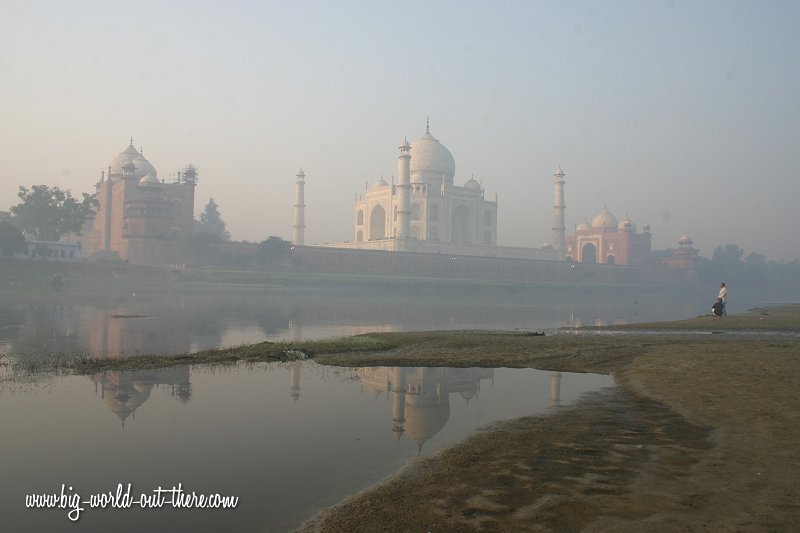
Located 9km from Srinagar city centre, Cheshma Shahi is the first Mughal garden one will pass after Nehru Park. The name means Royal (shahi) Spring (chashma). Small and charming, this Mughal garden was laid out by the Mughal Governor Ali Mardan Khan for Emperor Shah Jahan, famous for building the Taj Mahal, in 1632. Shah Jahan built a pavilion and laid out the Mughal garden in three terraces, each above the other by 18 feet. Cheshma Shahi is famous for the pure and refreshing spring that flows from it. Built at a height above the city, Cheshma Shahi offers a great view of the surrounding area with the Zabarwan hills behind it.

The next Mughal garden along the road that encircles the Dal is the Nishat Bagh, 11 km from Srinagar. Nishat Bagh means Garden of Gladness. This Mughal garden was built by empress Nur Jahan's brother Asaf Khan, in 1633-4. Originally, Nishat Bagh had twelve terraces, stretching all the way down to Del Lake, but the lower terraces no longer existed today, when the road around the lake was built. One of the most beautiful spot in Nishat Bagh is the second terrace with its high, broad cascade of sparkling water. There are two pavilions in this Mughal garden, one at the lower and another the higher end of the garden. In the midst of Nishat Bagh is a reservoir, fourteen feet square and three feet deep. The central channel gets its water from the Arrah Stream. The Nishat Bagh offers a magnificent view of Dal Lake, with the Zabarwan hills as the backdrop.

The third Mughal garden, the Shalimar Bagh, was laid out on a site where a garden has been in existence since ancient times. As early as King Pravarsena II, founder of Srinagar, there is said to be a villa where the king used to rest. The villa has disappeared, but around it grew a village which became known as Shalimar.

The Mughal garden of Shalimar Bagh was planted by Emperor Jahangir in 1619 for his beloved wife, Empress Nur Jahan. Shalimar Bagh has a canal lined with fountains, and water flowing from a higher level to a lower ones to form a pleasant cascade. Shalimar Bagh consists of four terraces. Like Nishat Bagh, Shalimar Bagh got its water from the Arrah stream.


Mughal Garden Photo Albums

Mughal Garden 1: Chesha Shahi


Mughal Garden 2: Nishat Bagh


Mughal Garden 3: Shalimar Bagh


Tim relaxes on a bed of autumn leaves at Nishat Bagh.


Expedia.com

Click here to return to the AsiaExplorers Homepage

How much have you explored India? Through AsiaExplorers, you can now explore these places in India from the comfort of your desk: Agra, (Akbar's Mausoleum at Sikandra, Agra Fort, Badshahi Darwaza, Buland Darwaza, Fatehpur Sikri, Hujra, Jama Masjid Fatehpur Sikri, Taj Mahal, | Taj Mahal In the Morning, | Taj Mahal in the Evening, Tomb of Sheikh Salim Chishti), Delhi, (Bahai Lotus Temple, Barber's Tomb, Bu Halima Enclosure, Humayun's Tomb, India Gate, Isa Khan's Tomb, Jama Masjid, Khan-i-Khanan's Tomb, National Museum of India, New Delhi Railway Station, Parliament Building, Qutub Minar, Rashtrapati Bhavan, Red Fort, Diwan-i-Aam, Diwan-i-Khas, Hammams, Indian War Museum, Khas Mahal, Lahore Gate, Moti Masjid, Mumtaz Mahal, Rang Mahal, Safdarjung's Tomb, Shri Lakshmi Narain Temple, Tughlaqabad Fortress, Jaipur, Albert Hall, Amber Fort, Birla Mandhir, Chandra Mahal, City Palace Museum, Diwan-i-Khas, Hawa Mahal, Jal Mahal, Jantar Mantar, Kesar Kyari Bagh, Moti Doongri, Rajendra Pol), Kashmir, Srinagar, (Cheshma Shahi, Dal Lake, Gulmarg, Kashmiri People of Srinagar, Mughal Gardens, Nishat Bagh, Shalimar Bagh), Mumbai, Sarnath, (Ashokan Pillar, Bodhi Tree of Sarnath, Chaukhandi Stupa, Dhamekh Stupa, Dharmarajika Stupa, Digambara Jain Temple, Mulagandha Kuty Vihara, Nichigai Suzan Horinji Temple, Sarnath Archaeological Museum), Varanasi, (Galis of Varanasi, Ganges, Ghats of Varanasi, Ahilyabai Ghat, Babua Pandey Ghat, Bundi Parkota Ghat, Chousaiti Ghat, Darbhanga Ghat, Dashaswamedh Ghat, Digpatiya Ghat, Ganesh Ghat, Kshameshwar Ghat, Lali Ghat, Lalita Ghat, Manikarnika Ghat, Man Mandir Ghat, Munshi Ghat, Raja Ghat, Ranamahal Ghat, Scindia Ghat, Vijaya Nagaram Ghat, Cantonment Railway Station, Gyanvapi Mosque, Malviya Bridge, Market Scene, Night Scene, People of Varanasi)


Grab this swicki from eurekster.com


Copyright © 2003-2008 AsiaExplorers.  All rights reserved.

About the Author: AsiaExplorers is researched and written by Timothy Tye. We take reasonable care to check and verify the accuracy of the content. However, we disclaim any responsibility for any inconvenience, mishap, injury or death resulting from following the advice provided directly or indirectly by AsiaExplorers and the comments on its pages. All the photographs in AsiaExplorers are available for publication. Please contact AsiaExplorers at the following email address for your enquiries: