This sight is located in Delhi, India. For travel information about Delhi, read the Delhi Travel Guide. To prepare for a trip to India, read also the India Travel Guide. Looking for budget accommodation? Use AsiaExplorers Budget Accommodation Guide, the no-frills website to cover your budget accommodation needs.
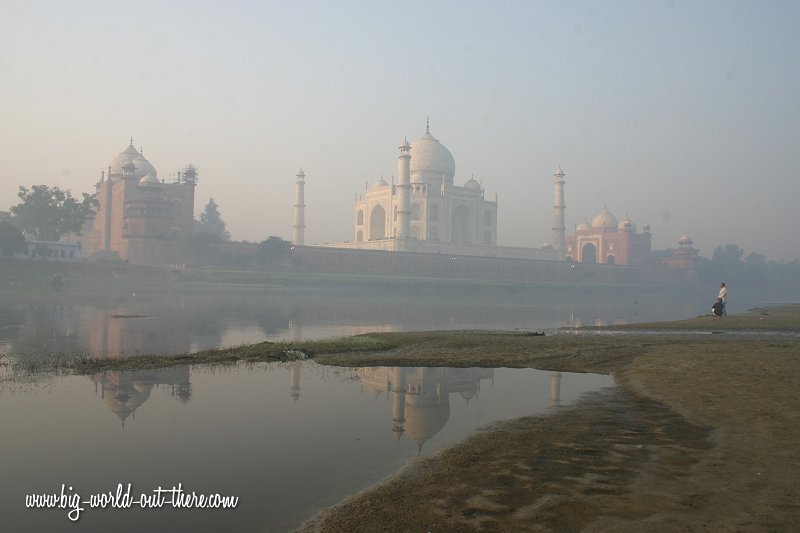
Safdarjung's Tomb represents the twilight years of Mughal rule in India. It was the last of the mausoleums of the Mughal dynasty. The It was constructed by Shuja-ud-Daula in 1753-54 AD for his father, Mirza Mukin Abul Mansur Khan 'Safdarjung'. Mirza Mukin Abul Mansur Khan was the wazir of emperor Ahmed Shah and Safdarjang was a title, either awarded to him by the king, or he assumed himself. The tomb is among the last example of the Mughal style tomb architecture.
The tomb was built by an Abyssinian (Ethiopian) architect, Bilal Mohammed Khan, at the exorbitant cost of Rs 3 lakhs. The marble and sandstone facing used for it was abstracted from the tomb of Abdul Rahim Khan-i-Khanan. The tomb is made of buff-colored sandstone with the intermittent use of red sandstone and marble. The central structure has double-storey minarets at the corners and a bulbous marble dome. Small hard-baked lakori bricks were used in the construction.
Safdarjung's Tomb.
While the dimensions of Safdarjang's tomb are good, the workmanship is often found to be wanting if compared with earlier Mughal tombs. The central chamber is carved and finely polished, surrounded by oblong and square compartments. Sunlight enters through the latticework. The three-domed and arched mosque with whaleback roofing at the entrance is a later addition. Arches and domes were believed to be introduced to India from Turkey and Persia.
The Arabic inscription on the gateway to the tomb reads, "When that hero of the plain of bravery departs from his transitory world, may he become resident of God's highest paradise (Hegira 1167; AD 1754)."
Safdarjung's Tomb today houses the sub-office of the Archaeological Survey of India (ASI), which organizes heritage walks under the aegis of the India Habitat Center.
Safdarjung's Tomb Photo Gallery
View of Safdarjung's Tomb from the entrance gate.
The chambers at the entrance to Safdarjung's Tomb.
A door at Safdarjung's Tomb.
View of Safdarjung's Tomb with its watercourse.
The formal garden surrounding the mausoleum at Safdarjung's Tomb.
View of the mausoleum from a different angle.
A closer view of the mausoleum at Safdarjung's Tomb.
About the Author: AsiaExplorers is researched and written by Timothy Tye. We take reasonable care to check and verify the accuracy of the content. However, we disclaim any responsibility for any inconvenience, mishap, injury or death resulting from following the advice provided directly or indirectly by AsiaExplorers and the comments on its pages. All the photographs in AsiaExplorers are available for publication. Please contact AsiaExplorers at the following email address for your enquiries: