Pematang Purba
North Sumatra, Indonesia


This sight is located in Sumatra, Indonesia. To prepare for a trip to Indonesia, read also the Indonesia Travel Guide. Looking for budget accommodation there? Use AsiaExplorers Budget Accommodation Guide, the no-frills website to cover your budget accommodation needs.


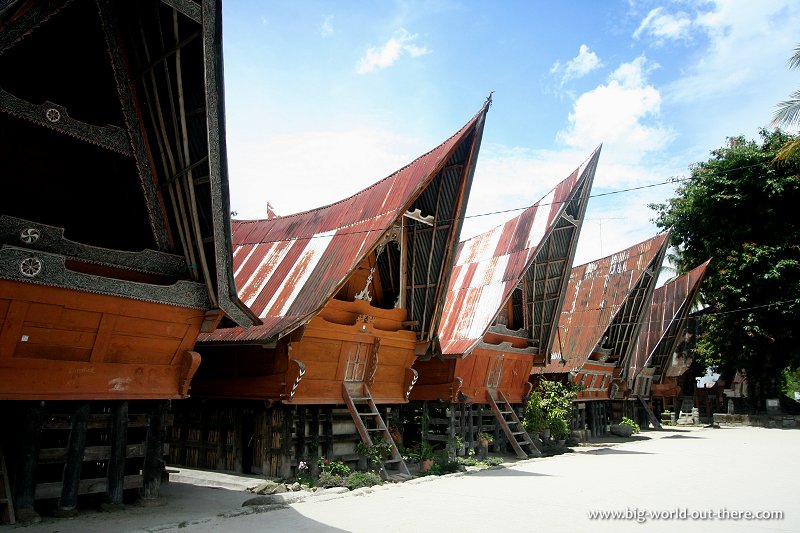
This is the wives' apartment. The dozen or so wives each occupy their respective quarters.


Pematang Purba (often wrongly spelled as Permatang Purba), 54 km from Pematangsiantar, is a village in northern Sumatra where the restored tribal houses of the Simalungan Batak chiefs are located. These tribal houses are now a museum. The word "Purba" is the name of the dynasty.
I visited Pematang Purba with some members of AsiaExplorers. Some how our guide thought this sight is not in the itinerary - he has not even been here for years - but we persuaded him to take us there. Lucky that we did, because the visit offered us an opportunity to view an authentic Batak tribal house without being tainted by commercialism.

The reign of the Purba dynasty began in 1624 with the first Simalungun Batak king, Tuan Pangultop Ultop, and continued until 1947 with the 14th and last Simalungun Batak king, Tuan Mogang, after which the Simalungun Batak kingdom was integrated into the newly independent Indonesia. I list down below all the Simalungun Batak kings and their reign. The king originated from Pak Pak, a village close to Acheh province.

Among the tribal houses is the Rumah Bolon, or long house of the Batak chief. It was built by the XII Chief of the Bataks, Tuan Rahalim. The long house was built of solid teak and stand on twenty poles. The roof gables are ornately decorated with designs in red, black and white, the traditional Batak colours. These colours carry special significance, white denotes the holy spirit, red denotes the way of life, and black denotes black magic.

In the middle of the living quarters is a pole with buffalo horns. These signify the supremacy of the Batak chiefs. The more horns there are, the more powerful the chief is regarded. The buffalo motif is carried out into the design of the longhouses as well, and appears on the roof ridge.

The inside of the Batak longhouse is dark and a bit spooky. The long house consists of living quarters, with cooking area, and a sleeping quarters with apartments for each of the chief's 24 wives (some accounts say 12 wives, I am not sure which one is correct).

The poles holding up the longhouse is adorned with intricate designs that evoke comparison with those of the Orang Ulu of Sarawak, designs which are now a popular tattoo choice in the West.

The Batak kings (or chiefs) are all Christians, so you can see Christian motifs mixed with their age-old animist motifs in the design of their houses as well as in their graves, which are located within the longhouse compound.

Kings of the Purba Dynasty

  1. Tuan Pangultop Ultop, 1624-1648
  2. Tuan Ranjinman, 1648-1669
  3. Tuan Nanggaraja, 1670-1692
  4. Tuan Batiran, 1692-1717
  5. Tuan Bakkaraja, 1718-1738
  6. Tuan Baringin, 1738-1769
  7. Tuan Bona Batu, 1769-1780
  8. Tuan Raja Ulan, 1781-1796
  9. Tuan Atian, 1800-1825
  10. Tuan Horma Bulan, 1826-1856
  11. Tuan Raondop, 1856-1886
  12. Tuan Rahalim, 1886-1921
  13. Tuan Karel Tanjung, 1921-1931
  14. Tuan Tuan Mogang, 1933-1947


Pematang Purba Photo Album


One of the traditional houses in the Simalungun Batak palace compound.


A monument commemorating the Batak kings stand beside a pavillion.


One of the out-houses in the tribal complex.


The ancient pavillion can still be used today.


The Rumah Bolon, or longhouse, of the Simalungun Batak chief.


The poles holding up the longhouse is intricately ornamented. Doesn't the design look like those of the Orang Ulu of Sarawak?


The living quarters inside the longhouse is very dark. In the middle is a pole with buffalo horns.


Tribal instruments.


The buffalo motif is repeated on the roof ridge.


Tim at the entrance into the wives' living quarters.


Expedia.com


Copyright © 2003-2008 AsiaExplorers.  All rights reserved.

About the Author: AsiaExplorers is researched and written by Timothy Tye. We take reasonable care to check and verify the accuracy of the content. However, we disclaim any responsibility for any inconvenience, mishap, injury or death resulting from following the advice provided directly or indirectly by AsiaExplorers and the comments on its pages. All the photographs in AsiaExplorers are available for publication. Please contact AsiaExplorers at the following email address for your enquiries: