Home Iraq (العراق) Travel Guide


Exotic Tours of Asia
 Asia Travel Guide Find Hotels       
Tigris River, Baghdad
Author: Zzztriple2000 (public domain)


Iraq is a country in the Middle East, also broadly defined as in Western Asia. It covers 438,317 sq km (169,234 sq mi) and has a population of 31.5 million people (2011 estimate). The capital and biggest city is Baghdad.

Iraq is bordered by Iran to the east, Kuwait to the southeast, Saudi Arabia to the south, Jordan and Syria to the west, and Turkey to the north.


Iraqi boys outside the Amiriya bomb shelter, Baghdad
Author: Christiaan Briggs (Creative Commons Attribution 3.0 Unported)

Iraq is three hours ahead of Coordinated Universal Time (UTC+3). Traffic is driven on the right. The phone IDD code is +964. The electricity is 230V/50Hz. In 2009, Iraq had an estimated nominal GDP of $65.838 billion, equivalent to a per capita nominal GDP of $2,108. Its per capita GDP at purchasing power parity is $3,570.

Iraq today is a federal parliamentary republic headed by a president, Jalal Talabani, and a prime minister, Nouri al-Maliki. The official language are Arabic and Kurdish. 97% of the population are Muslims, of which around 60% are Shi'a Muslims and 35% Sunni Muslims.

The land of present-day Iraq bears one of the earliest evidence of human civilization on each. The Sumerian civilization appeared here in the 4th millennium BC, giving birth to the first writing system in the world, which in turn enabled recorded history to appear.

In the 18th century BC, another civilization, Babylon, rose in central and southern Iraq while at the same time, the Assyrian civilization appeared in northern Iraq. In those times the land was known in Ancient Greek as Mesopotamia (Μεσοποταμία).


The reconstructed Great Ziggurat of Ur, Iraq
Author: The US Army (public domain)

Mesopotamia was converted to Islam when the Muslims conquered it in the 7th century. The city of Baghdad was founded by the Abbasid Caliphate in the 8th century. It grew to become a major Muslim metropolis and one of the most important cities in the Arab world for five centuries.

Baghdad was destroyed by the Mongols, under Hulagu Khan, in 1257 after its leader, the Abbasid Caliph Al-Musta-sim refused to surrender. Between 200,000 to a million people were killed in the invasion. Many important and precious items of that period were also destroyed. Much of the irrigation infrastructure that has been in place for centuries were similarly destroyed.

The next century saw the Black Death ravaging much of the Islamic world including Iraq, shaving a further third of its population. Next came the invasion by the Mongol descent, Timur Lenk, who captured Baghdad in 1404. In the event, 20,000 people of Baghdad were massacred.


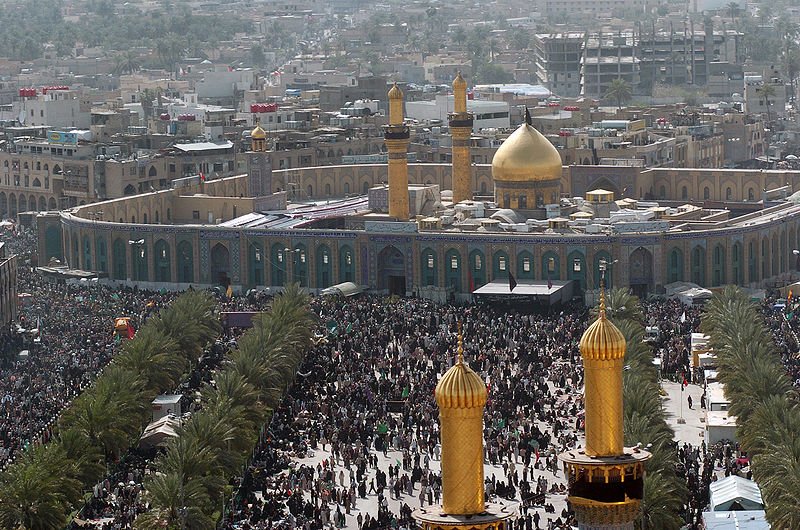
Imam Husayn Mosque in Karbala, Iraq
Author: SFC Larry E. Johns, USA (public domain)

Iraq passed into the control of the Ottoman Empire in the 16th century. During this period, warfare constantly erupted with neighboring powers asserting their control over Iraq at every given opportunity.

Ottoman rule came to an end in World War I, and Iraq was created by French and British forces under the Sykes-Picot Agreement in 1916. The State of Iraq was born on 11 November, 1920. It was a kingdom headed by King Faisal, who ruled Iraq from 1921 to 1933, and was also the king of the shortlived Arab Kingdom of Syria in 1920.

Iraq was granted independence from Britain in 1932. King Faisal was succeeded by his son, King Ghazi, who was a figurehead king until his own death in 1939, when he was succeeded by his underaged son Faisal II. The kingdom was overthrown on 1 April 1941 by Rashid Ali, sparking the Anglo-Iraqi War.

The monarchy was reinstated and lasted until 1958, when it was again overthrown, this time by the Iraqi Army, putting Brigadier General Abdul Karim Qassim in power. He lasted till 1963, when he too was brought down by another coup by Colonel Abdul Salam Arif, succeeded three years later by his brother Abdul Rahman Arif.

Abdul Rahman Arif was subsequently overthrown in 1968 by the Arab Socialist Baath Party, setting the stage for the appearance of Saddam Hussein, who took power as Iraqi President in 1979. The following year he declared war on Iran, claiming that Iranian forces were attempting to topple his government. The war which claimed over a million lives ended in stalemate in 1988.


Kadhimayn Mosque, Baghdad
Author: Toushiro (public domain)

Between 1986 and 1988, Saddam Hussein's Iraqi regime launched the al-Anfal campaign targetting the Kurdish population as well as other minority groups such as the Shabaks, Yazidis, Jews, Mandeans and Turcomans, resulting in the death of hundreds of thousands of civilians within its own borders.

In 1990, Saddam Hussein declared war on Kuwait, which was overproducing oil, causing a glut that deflated oil prices, leading to lower oil revenues for Iraq. Iraq swiftly occupied Kuwait, then declared that Kuwait was to be a province of Iraq. This resulted in UN economic sanctions and military action against Iraq.

In 2003, the United States led a military invasion of Iraq, on reason that it failed to abandon its nuclear and chemical weapons, and that Iraq was developing weapons of mass destruction. Once the Iraqi regime was ousted, the United States established a Coalition Provisional Authority to govern Iraq. On 13 December, 2003, Saddam Hussein was captured in Operation Red Dawn. He was hanged on 30 December, 2006.

US Forces began withdrawing from Iraq on 29 June, 2009, with plans to fully leave the country by 31 December, 2011. However, in the months since US withdrawal began, incidence of crime and violence have spiked as the Iraqi security forces struggled to keep order.

Planning your trip to Iraq

Iraq is still presently a war zone and extremely dangerous to casual visitors. In fact, tourist visas are not being granted yet.

Preparing Money for your trip to Iraq

The currency used in Iraq is the Iraqi Dinar (IQD). The following are the latest rates for Iraqi Dinar in the last 24-hours.


Major Towns in Iraq

  1. Baghdad
  2. Arbil
  3. Ar Rutba
  4. Basra
  5. Dahuk
  6. Fallujah
  7. Karbala
  8. Kirkuk
  9. Mosul

Places of Interest in Iraq

  1. Babylon
  2. Ctesiphon
  3. Nineveh
  4. Ur

UNESCO World Heritage Sites in Iraq

  1. Hatra
  2. Ashur (Qal'at Sherqat)
  3. Samarra Archaeological City


Return to Asia Travel Guide
Return to Discover This World


  • Tips to become a smart traveler: Useful tips to remember, to get the best out of your travels.
  • Preparing for a Trip: Systematic approach to help you prepare for your trip.
  • How to plan your travel itinerary: Step-by-step guide to creating the itinerary for your trip.
  • Find and compare hotel room rates: View room rates from all the different booking sites.
  • Learn to compare room rates: Step-by-step guide on finding the lowest rates every time.
  • When NOT to go where: List of seasons to avoid when traveling the globe.
  • How to pack your luggage: Useful steps to take when packing your luggage.
  • Packing List (PDF): Print out this free packing list to make sure you don't forget anything for your trip.
  • Voltage, Frequency, Plugs & Sockets of the World: Learn about the mains electricity supply in the world.
  • Travelers' List of Plugs and Sockets (PDF): Easy-to-use list of electricity and plugs for all countries.
  • Making International Direct Dail Calls: Learn to make IDD calls from anywhere in the world.
  • IDD Call Prefixes & Country Codes (PDF): Listing of Call Prefixes and Country Codes on one page for you to bring on your trip.
  • Safety Tips When Traveling Alone: Useful advice for when you travel on your own.
  • Guide to Health Matters related to Travel: Comprehensive coverage of different issues related to your health when traveling.
  • Getting Travel Insurance for your trip: Benefits of travel insurance, and advise on when you should signing up for one.
  • Improve your travel photography: Tips to improve your photography skills, especially when traveling.
  • Guide to Traveling Around the World: Useful tips for encircling the globe.
  • English Made Simple: Improve your English for your travel.


  • Follow Me on Pinterest

    Point - Click - Discover!

    Thanks for visiting this webpage. To continue exploring, choose another destination!


    My World Travel Guides - celebrating a beautiful world beautifully.


    SBI! Results