Home Japan (日本) Travel Guide


Exotic Tours of Asia
 Asia Travel Guide Find Hotels       
Mount Fuji from Lake Shoji, Yamanashi prefecture
Author: Fg2 (public domain)


Japan explains the places and sights in Japan for the benefit of those going there. We will visit all the major cities as well as towns and villages in Japan, getting to know the sights and tourist attractions along the way.


Himeji Castle
Himeji Castle
Author: Quasipalm (Creative Commons Attribution 3.0 Unported)


My purpose for creating My Japan Travel Guide is to have one of the most complete personal travel website describing Japan to travelers. It doesn't matter whether you are going to Japan for a few days or several weeks, My Japan Travel Guide is an easy tool you can refer to, anywhere in Japan.

Introducing Japan

Japan (日本国) is a country in East Asia. It comprises four main islands to the east of the Sea of Japan, namely Honshu, Hokkaido, Kyushu and Shikoku, and with over six thousand smaller islands and islets within an archipelago. Countries neighboring Japan includes South Korea, North Korea, China and Russia. The name Japan means "origin of the sun", which is why the country is often called "Land of the Rising Sun".

Japan covers an area of 377,944q sq km (145,925 sq mi). The country has a population of 127 million people concentrated mostly in the densely populated Kanto and Kansai plains. Its capital, Tokyo, is a metropolis with a population exceeding 35million people, making it one of the most populous metropolitan areas in the world.


Japanese lanterns at the Kitano-tenmangu Shrine
Author: Tomomarusan (Creative Commons Attribution 3.0 Unported)

Guide to Japan Hotels

It's never easy finding the hotel that's just right for your stay. Still, by taking a little time to do your research, you increase your chance of getting a good hotel at the best price. Go through the list of hotels in Japan which we've put together, arranged city by city, with full description, star rating, address, location map and evaluation. Pick the hotel of your choice and view the rates offered by different booking sites. Yes, we show you prices from different websites, so you don't have to visit them one by one.

More about Japan

The modern English name for Japan differs from the official Japanese name of the country, Nippon/Nihon. This is due to influence from early trade routes. Chinese traders of Fujian descent called the country Jit Pun, which became Jepun in Malay, Jepang in Indonesian, and eventually Japan in English.


Sushi
Sushi
Author: Nesnad (Creative Commons Attribution 3.0 Unported)


Japan comprises 47 administrative regions known as prefectures. The prefectures include one metropolis (Tokyo), one "circuit" (Hokkaido), two urban prefectures (Osaka and Kyoto), and 43 "ken" (regional prefectures).

The metropolis of Tokyo is subdivided into administrative divisions called ward, of which there are 15. Hokkaido is divided into 14 subprefectures, each with a branch office ("shicho") of the prefecture. The regional prefectures are subdivided into cities ("shi") and districts ("gun").

Japan is today the world's second largest economy, and third largest in terms of purchasing power parity. It is also the world's fourth largest exporter and fifth largest importer. It is a developed nation with a very high standard of living, with the 10th highest Human Development Index. It also has the highest life expectancy of any country in the world, and the third lowest infant mortality rate.


Dohyo-iri Ceremony, performed during the Sumo tournament in Ryogoku, Tokyo
Author: Keith Pomakis (Creative Commons Attribution ShareAlike 2.5 Generic)

Planning your trip to Japan

Japan is often perceived as an extremely expensive destination. While it is certainly more expensive than many others in Asia, visitors are still able to enjoy a visit to Japan on a limited budget. It is certain not any more expensive than visiting countries in Western Europe or North America.

Many people come to Japan to enjoy an exotic destination which has managed to preserve its heritage while remaining at the cutting edge of science and technology. There is much to see in Japan that can be considered unique, and hence, exotic to foreign visitors. The people has preserved and developed their culture to a degree that few has achieved, free from excessive interference from outsiders. The country "borrows" heavily from its neighbors as well as from the West, readapting the borrow and turning it into a hybrid which is their own.


The famous Suizenji Japanese Garden in Kumamoto
Author: 663highland (Creative Commons Attribution 3.0 Unported)


The majority of overseas visitors arrive in Japan at either Narita Airport near Tokyo, or Kansai Airport near Osaka. A smaller number also uses the Chubu International Airport near Nagoya. Find out from the Japanese embassy nearest you whether you would need a visa for entry to Japan. Citizens of 61 countries and territories don't, but to curb the influx of illegal immigrants into the country, Japan has placed visa requirements on most nationals of Asian countries. Upon arriving, you are required to undergo electronic fingerprinting, refusal of which is ground to deny you entry.

Preparing Money for your trip to Japan

The currency used in Japan is the Japanese Yen (JPY). The following are the latest rates for Japanese Yen in the last 24-hours.

Planning your travel within Japan

Japan has one of the best train network in the world. It can be exceedingly complex, but if you know exactly where you are going, you will have little problem getting there. Traveling in Japan is very expensive compared to other countries in Asia. However, whether you are using road or rail, you can expect everything to be maintained at tip-top condition.


Torii of Itsukushima Shrine
Author: Alex Tora (public domain)


The fastest way to go from one big city to another is to take the famous bullet train, called the Shinkansen, operated by Japan Railways Group, JR, which was once a single entity, but now broken into seven different companies, six servicing different regions of Japan, and one for freight. JR does not have an exclusive monopoly on all the railway lines in the country, but it pretty much covers the needs of most. If you intend to travel by train extensively, you should get the Japan Rail Pass, allowing you unlimited travel on (almost all) JR trains, including the Shinkansen for fixed periods of 7, 14 and 21 days. It can only be purchased outside Japan, but is a true money saver (a round trip between Tokyo and Osaka costs almost ¥29,000 alone, compared to the price of the 7-day Rail Pass of ¥28,300.)

An alternative to the Japan Rail Pass is the Shinkansen Tour. It is exclusive to foreigners only, but can be bought in Japan itself, allowing you excellent discounts plus accommodation to visit selected destinations in the country.


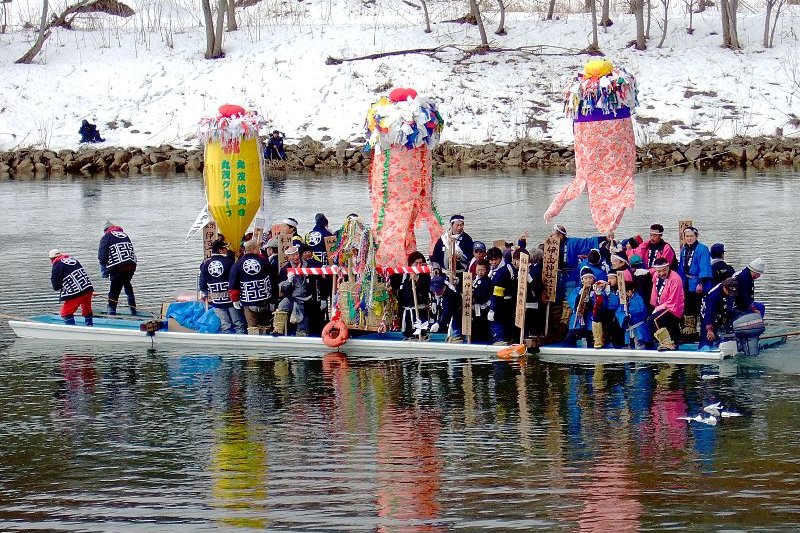
Festival Float in Japan
Author: 砺波夜高祭WEB管理人 (Creative Commons Attribution 3.0 Unported)

Roads in Japan

Japan has a network of roads connecting its cities and towns. These include expressways and national highways. The expressways in Japan are toll roads. In most cases, the toll is collected according to distance travelled. Extressways do not usually have a route number. Rather, they are known by their names, i.e. the Tomei Expressway, Shin-Meishin Expressway, etc. As of 2008, there is a total of 7,641 km of expressways in Japan. On Google Maps, the expressways are shown in green.

National highways are a grade below the expressways. They are signaged with a blue Highway Shield bearing the route number in white. Japan National Routes are categorized into two classes. Class 1 highways bear either a single or double-digit number, while Class 2 highways bear a three-digit number. The Highway Shield looks like this.


Highway Shield for Japan National Route 15
Author: excl-zoo (public domain)


Towns and Cities of Japan

  1. Tokyo - capital
  2. Aizuwakamatsu
  3. Akita
  4. Aomori
  5. Asahikawa
  6. Asakura
  7. Atami
  8. Beppu
  9. Chiba
  10. Daisen
  11. Date
  12. Dazaifu
  13. Echizen
  14. Iwaki
  15. Fujikawaguchiko
  16. Fujioka
  17. Fukui City
  18. Fukuoka
  19. Fukushima
  20. Furano
  21. Gifu City
  22. Goshogawara
  23. Hachinohe
  24. Hakodate
  25. Hakone
  26. Hakuba
  27. Hamamatsu
  28. Hida
  29. Hirakawa
  30. Hirosaki
  31. Hiroshima
  32. Ichinomiya
  33. Inuyama
  34. Imabari
  35. Ise City
  36. Ishigaki
  37. Ito
  38. Iyo
  39. Kagoshima
  40. Kamakura
  41. Kanazawa
  42. Kashiwa
  43. Katagami
  44. Katori
  45. Katsuura
  46. Kawasaki
  47. Kawagoe
  48. Kazuno
  49. Kiryu
  50. Kisarazu
  51. Kitaakita
  52. Kitakyushu
  53. Kobe
  54. Koriyama
  55. Koyasan
  56. Kuroishi
  57. Kurume
  58. Kyoto
  59. Maebashi
  60. Matsudo
  61. Matsuyama
  62. Minamisoma
  63. Misawa
  64. Motomiya
  65. Mutsu
  66. Nagakute
  67. Nagasaki
  68. Nagoya
  69. Nara
  70. Narita City
  71. Niihama
  72. Nikaho
  73. Nikko
  74. Noshiro
  75. Obama
  76. Odate
  77. Oga
  78. Okazaki
  79. Onjuku
  80. Ono
  81. Osaka
  82. Ota
  83. Ozu
  84. Sabae
  85. Saijo
  86. Sakai
  87. Sapporo
  88. Seiyo
  89. Semboku
  90. Sendai
  91. Seto
  92. Shikokuchuo
  93. Shirakawa
  94. Sukagawa
  95. Takasaki
  96. Takayama
  97. Tatebayashi
  98. Toon
  99. Towada
  100. Toyohashi
  101. Toyota
  102. Tsugaru
  103. Tsuruga
  104. Uwajima
  105. Yachimata
  106. Yanagawa
  107. Yawatahama
  108. Yokohama
  109. Yokote
  110. Yurihonjo
  111. Yuzawa

Prefectures of Japan

The regions are roughly arranged from north to south.
    Hokkaido
  1. Hokkaido Prefecture

  2. Honshu
    Tohoku region
  3. Akita Prefecture
  4. Aomori Prefecture
  5. Fukushima Prefecture
  6. Iwate Prefecture
  7. Miyagi Prefecture
  8. Yamagata Prefecture

  9. Kanto region
  10. Chiba Prefecture
  11. Gunma Prefecture
  12. Ibaraki Prefecture
  13. Kanagawa Prefecture
  14. Saitama Prefecture
  15. Tochigi Prefecture
  16. Tokyo Metropolis

  17. Chubu region
  18. Aichi Prefecture
  19. Fukui Prefecture
  20. Gifu Prefecture
  21. Ishikawa Prefecture
  22. Nagano Prefecture
  23. Niigata Prefecture
  24. Shizuoka Prefecture
  25. Toyama Prefecture
  26. Yamanashi Prefecture

  27. Kansai region
  28. Hyogo Prefecture
  29. Kyoto Prefecture
  30. Mie Prefecture
  31. Nara Prefecture
  32. Osaka Prefecture
  33. Shiga Prefecture
  34. Wakayama Prefecture

  35. Chugoku region
  36. Hiroshima Prefecture
  37. Okayama Prefecture
  38. Shimane Prefecture
  39. Tottori Prefecture
  40. Yamaguchi Prefecture

  41. Shikoku
  42. Ehime Prefecture
  43. Kagawa Prefecture
  44. Kochi Prefecture
  45. Tokushima Prefecture

  46. Kyushu
  47. Fukuoka Prefecture
  48. Kagoshima Prefecture
  49. Kumamoto Prefecture
  50. Miyazaki Prefecture
  51. Nagasaki Prefecture
  52. Oita Prefecture
  53. Saga Prefecture

  54. Okinawa
  55. Okinawa Prefecture

Japan Accommodation Guide

  1. Where to Stay in Japan
  2. Business Hotel in Japan
  3. Camping in Japan
  4. Capsule Hotels in Japan
  5. Hostels in Japan
  6. Love Hotels in Japan
  7. Staying at a Minshuku
  8. Staying at an Onsen
  9. Staying at a Pension
  10. Staying at a Ryokan
  11. Using a Sento
  12. Youth Hostels in Japan

UNESCO World Heritage Sites in Japan

  1. Buddhist Monuments in the Horyu-ji Area
  2. Himeji-jo
  3. Shirakami-Sanchi
  4. Yakushima
  5. Historic Monuments of Ancient Kyoto (Kyoto, Uji and Otsu Cities)
  6. Historic Villages of Shirakawa-go and Gokayama
  7. Hiroshima Peace Memorial (Genbaku Dome)
  8. Itsukushima Shinto Shrine
  9. Historic Monuments of Ancient Nara
  10. Shrines and Temples of Nikko
  11. Gusuku Sites and Related Properties of the Kingdom of Ryukyu
  12. Sacred Sites and Pilgrimage Routes in the Kii Mountain Range
  13. Shiretoko
  14. Iwami Ginzan Silver Mine and its Cultural Landscape

Understanding Japan

  1. Public Bathing House or Sento


Return to Asia Travel Guide
Return to Discover This World


  • Tips to become a smart traveler: Useful tips to remember, to get the best out of your travels.
  • Preparing for a Trip: Systematic approach to help you prepare for your trip.
  • How to plan your travel itinerary: Step-by-step guide to creating the itinerary for your trip.
  • Find and compare hotel room rates: View room rates from all the different booking sites.
  • Learn to compare room rates: Step-by-step guide on finding the lowest rates every time.
  • When NOT to go where: List of seasons to avoid when traveling the globe.
  • How to pack your luggage: Useful steps to take when packing your luggage.
  • Packing List (PDF): Print out this free packing list to make sure you don't forget anything for your trip.
  • Voltage, Frequency, Plugs & Sockets of the World: Learn about the mains electricity supply in the world.
  • Travelers' List of Plugs and Sockets (PDF): Easy-to-use list of electricity and plugs for all countries.
  • Making International Direct Dail Calls: Learn to make IDD calls from anywhere in the world.
  • IDD Call Prefixes & Country Codes (PDF): Listing of Call Prefixes and Country Codes on one page for you to bring on your trip.
  • Safety Tips When Traveling Alone: Useful advice for when you travel on your own.
  • Guide to Health Matters related to Travel: Comprehensive coverage of different issues related to your health when traveling.
  • Getting Travel Insurance for your trip: Benefits of travel insurance, and advise on when you should signing up for one.
  • Improve your travel photography: Tips to improve your photography skills, especially when traveling.
  • Guide to Traveling Around the World: Useful tips for encircling the globe.
  • English Made Simple: Improve your English for your travel.


  • Follow Me on Pinterest

    Point - Click - Discover!

    Thanks for visiting this webpage. To continue exploring, choose another destination!


    My World Travel Guides - celebrating a beautiful world beautifully.


    SBI! Results