Seoul Budget Travel Guide is created for the benefit of people planning to make a trip there. All the places of interest in Seoul is listed here along with a brief description. Each of the sight listed will eventually have its own dedicated page linked to this page.
About Seoul
Seoul is the capital and largest city in South Korea. It is a city of over 10 million people. The metropolitan area of Seoul, called the Seoul National Capital Area, includes the city of Incheon, itself the third largest city in South Korea, as well as much of Gyeonggi Province, together holding a population of about 25 million people - almost half of the total population of South Korea. It is the second largest metropolitan area in the world behind Tokyo and in front of Mexico City.
Seoul is located on the banks of the Han River. The area has been settled as early as 18 BC, when the Kingdom of Baekje - one of thge Three Kingdoms of Korea - established its capital to the southeast of present-day Seoul.
Seould was the capital of Korea during the Joseon Dynasty (1392-1897) as well as the Korean Empire (1897-1910). As such it is home to many royal palaces that are today national monuments.
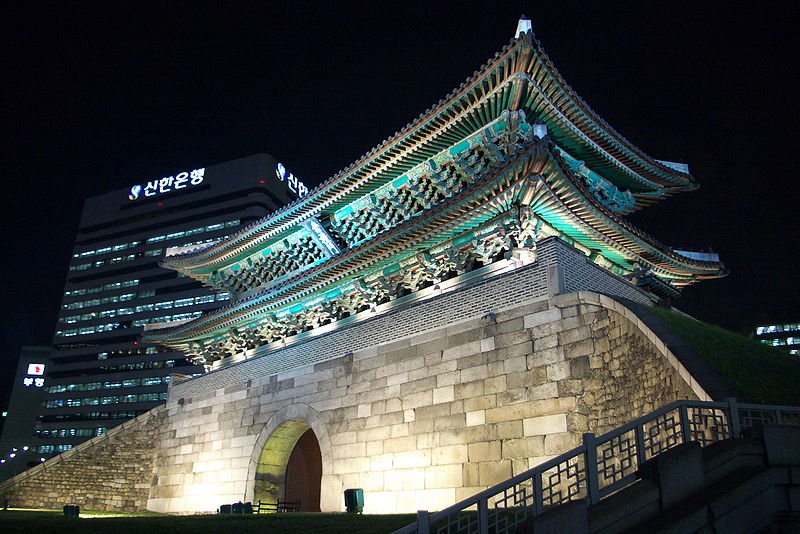
Seoul was known as Hanyang and then Hanseong throughout the Joseon Dynasty. The medieval city was enclosed by high walls punctuated by nine gates, of which five are still standing, and two of the biggest are Namdaemun and Dongdaemun.
When Japan invaded Korea in 1910, Seoul was made the colonial capital until the defeat of Japan in World War II. During the Korean War in 1950, there was a tussle for control over Seoul between the China-backed North Korean forces and the UN-back South Korean forces. When the Soviet Union and China came forward to assist North Korea, there was heightened threat of a world wide nuclear war, averted by the signing of an armistice on 27 July 1953. (North Korea unilaterally withdrew from the armistice on 27 May, 2009, in principle going back to a state of war).
The effect of the Korean War was utter devastation for Seoul, which also had to live with a flood of North Korean refugees, swelling its population of 2.5 million people. The South Korean government swiftly embarked on a reconstruction and modernization program. Standard of living started to rise through the 1960's and 70's. The city experience a construction boom of infrastructure and housing in the 1980's, entirely transforming the cityscape, but at the same time making traffic jams common place.
Seoul is today a densely populated metropolis, and one of the most expensive cities in the world. To relieve the pressure of congestion, the South Korean Government has since late 2004 begun relocating many of its government bodies to the city of Gongju, 120 kilometers south of Seoul, and at a more comfortable distance from the border with North Korea. Seoul remains a capital by name - it is not constitutional to move it without a national referendum or revision of the constitution.
Budget Travel to Seoul
The Incheon International Airport (ICN) is the main gateway to Seoul and to South Korea. It is located on an island in neighboring Incheon.
Leaving the airport by bus
The most practical was to leave Incheon Airport is to take an airport limousine bus. The fare to downtown Seoul is ₩14,000, stopping at major hotels in Seoul. If you are transferring to Gimpo Airport for a domestic flight, the fare is ₩6,500.
A more economical option is to take the public bus. It goes from Incheon Airport to the bus hub in downtown Seoul, and costs around ₩8,000 to ₩9,000. If you are in doubt which bus to take, ask one of the ticket sellers.
Leaving the airport by train
The Korea Airport Railroad Express, AREX is an express train out of Incheon Airport. Unfortunately at the moment it runs all the way till Gimpo Airport only, so if you take it, you still have the transfer to a subway, taking Line 5 or Line 9 to reach downtown Seoul. The AREX is presently being extended to Seoul, but the phase is not completed yet. If you are lugging a lot of baggage, then I would suggest you take the limousine bus.
Budget Travel within Seoul
Seoul has an extensive subway network covering most of the places within the city. There are presently 9 Metropolitan Subway Lines, excluding the Bundang Line and the Incheon Line. They are all color coordinated to help you differentiate one from the other. All signages include English. For the latest subway map, visit the Seoul Metropolitan Rapid Transit website.
The Seoul subway fare is charged according to distance traveled. It starts at ₩1000. Tickets are sold by vending machines, all of which accept coins and a few banknotes too. However, the machines will not take a note of high denomination, say ₩10,000. Nonetheless there is usually a bill exchanger nearby.
If you plan to use the subway often, you should get the stored value T-Money smart card. The card itself costs ₩2,500, but you save ₩100 each time you make a transfer. The T-Money card can also be used to pay taxi fares, bus fares and other conveniences.
Before booking a hotel room, make sure you are getting the lowest price for it. Different hotel booking websites offers the same room at different prices. If you stick with one site all the time, you could be paying more for the same room. Now why pay more?
The form below is a Research Engine. It doesn't take bookings. Instead it lets you find the hotel booking website that offers the room you want at the lowest price. You can see and compare what different sites are offering, and then click to choose the one with the best price. Do this, and you're guaranteed to save a whole lot of money on your room reservations!
If you're flying somewhere, use our Flight Checker to compare the rates from different airlines. To use it, enter where you will be flying from, where you will be flying to, your departure date and return date. Select the number of passengers, and then click search.
Our engine will return you a list of possible flights that you can take. You can compare the fare of different airlines for your trip. Click on your selected airline, and we transfer you to the airline website.
AsiaExplorers is researched and written by Timothy Tye. Reasonable care is taken to check and verify the accuracy of the content. AsiaExplorers disclaims responsibility for any inconvenience, mishap, injury or death resulting from following the tips and advice provided directly or indirectly by this website. All pages may be printed out for your own personal, non-commercial use. You may use the information on this website on your blog or website so long as you place a dofollow link back to the page in AsiaExplorers where it appears. Photographs not credited to a third party belong to Timothy Tye and may not be reused in any form unless you are first given permission. Write in to inquire if interested. Third party photographs are governed by their respective licenses. To contact Tim, write to the following email address: