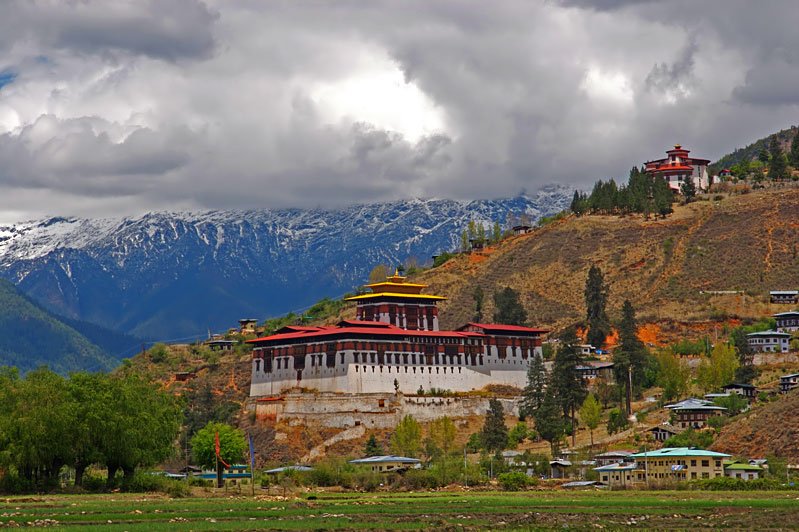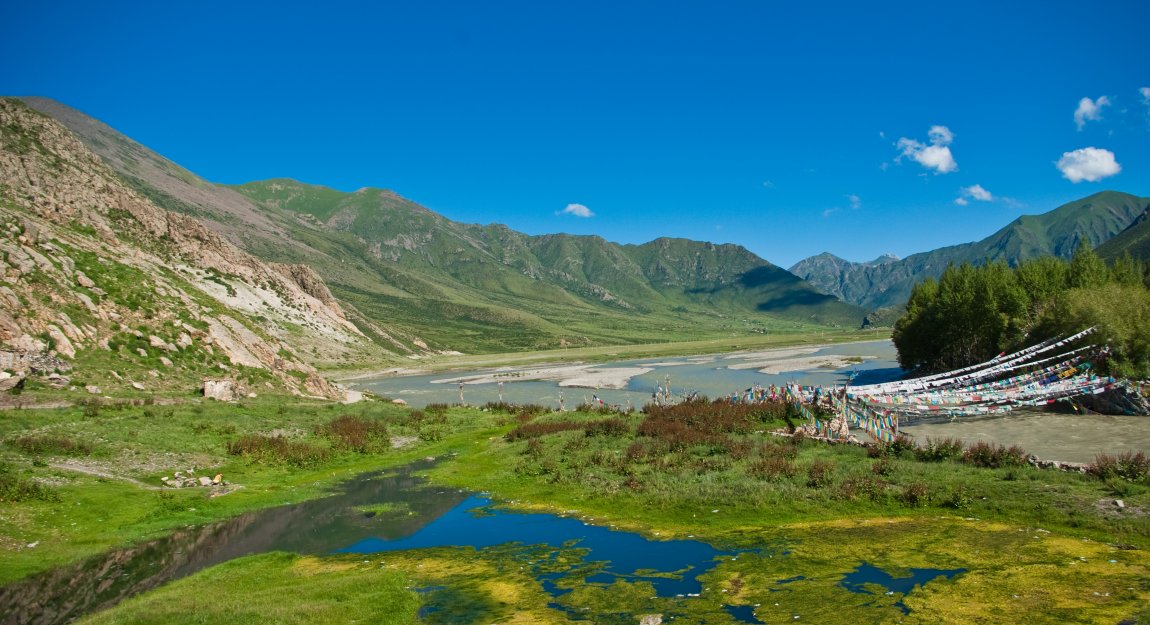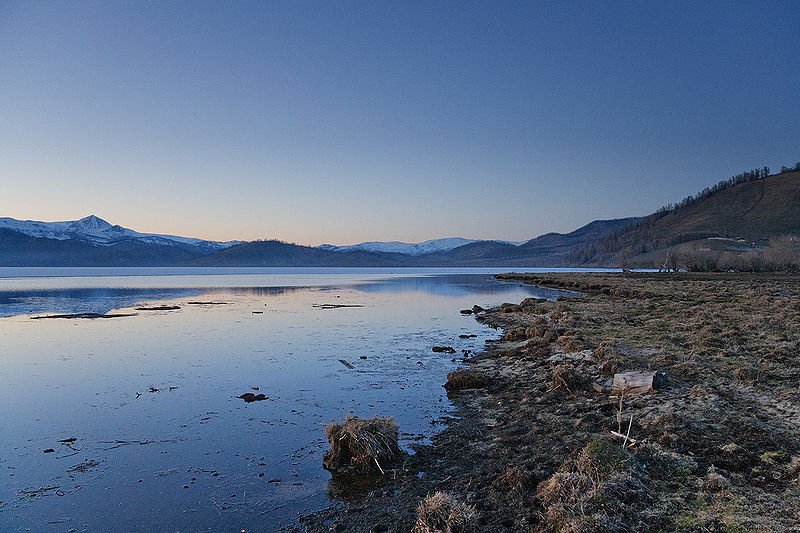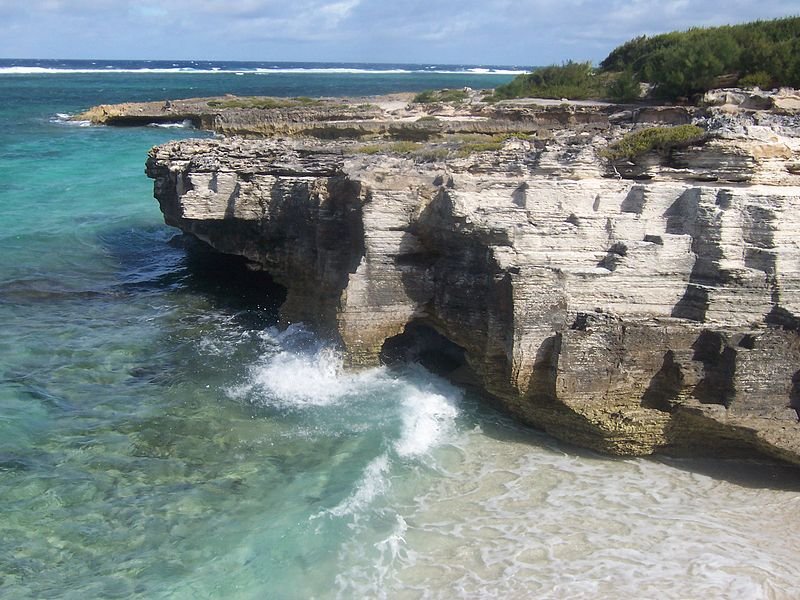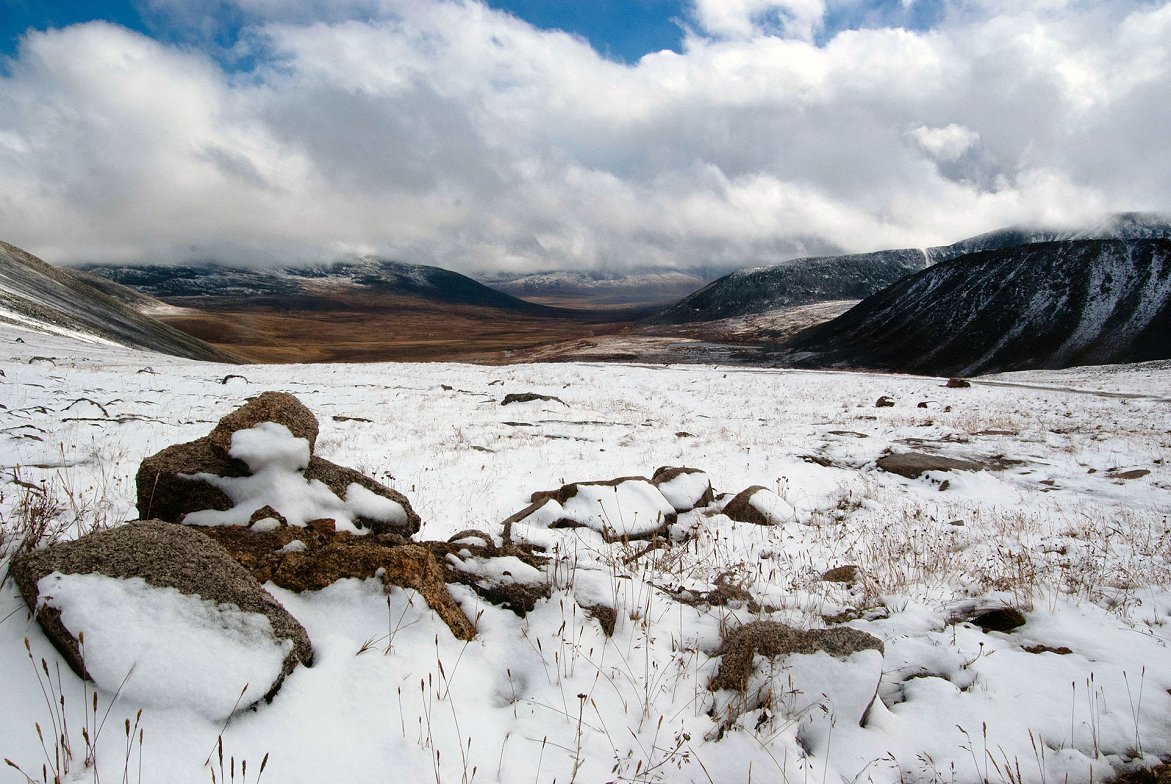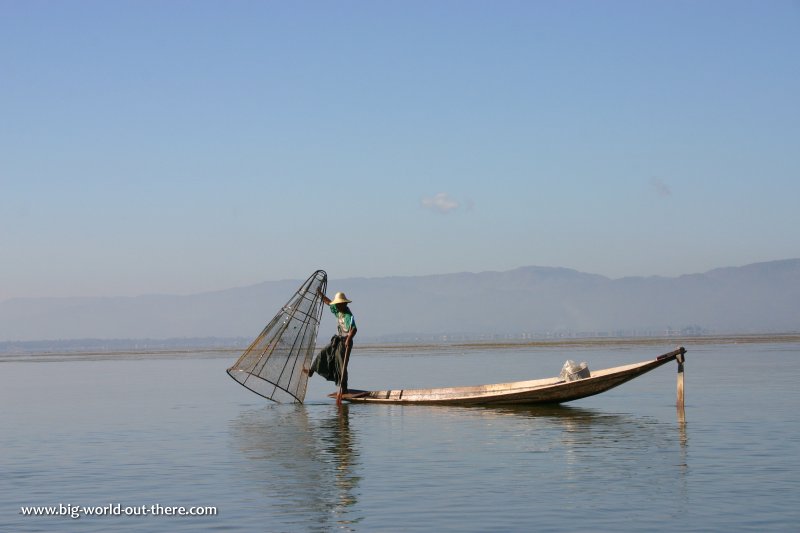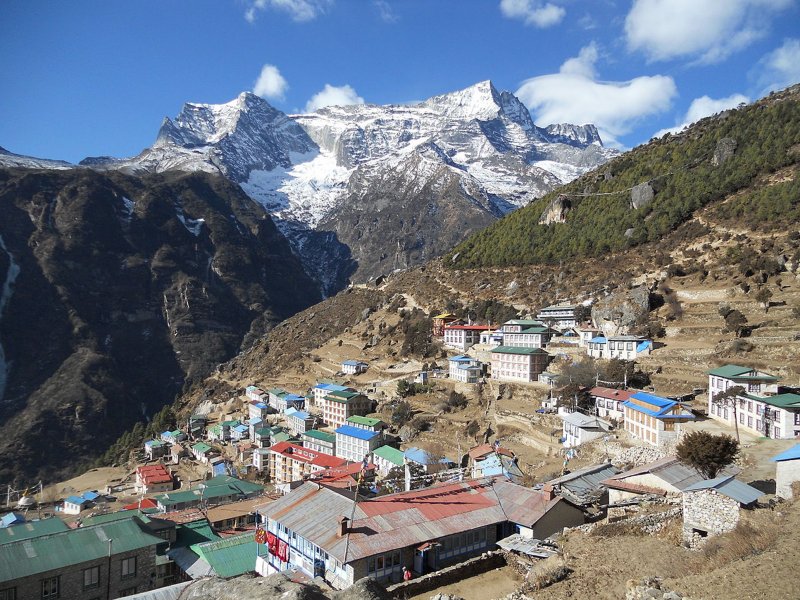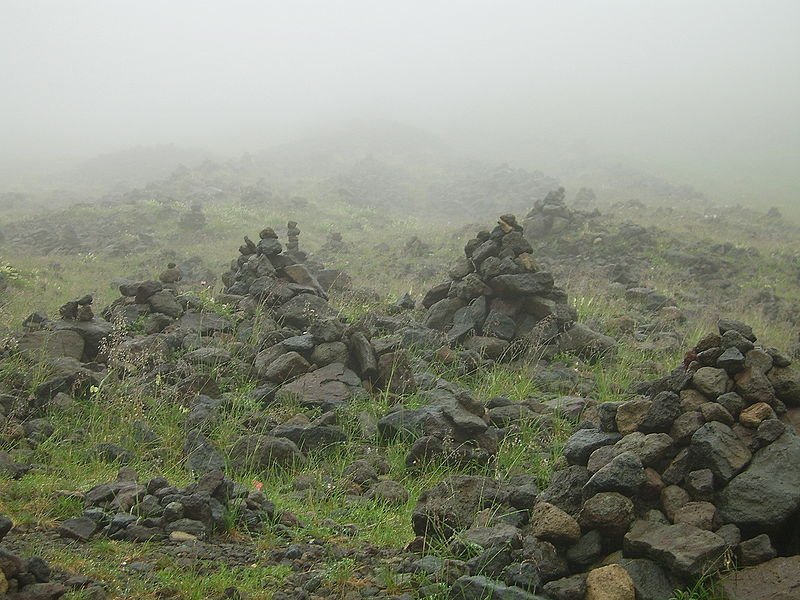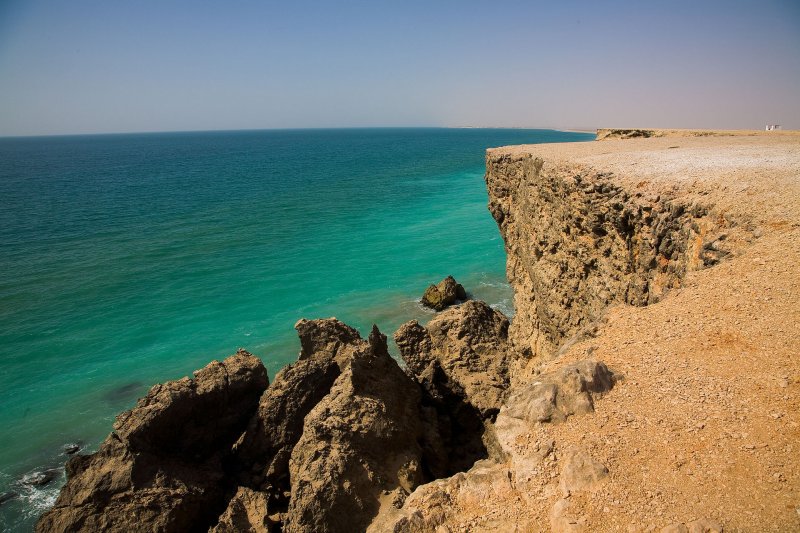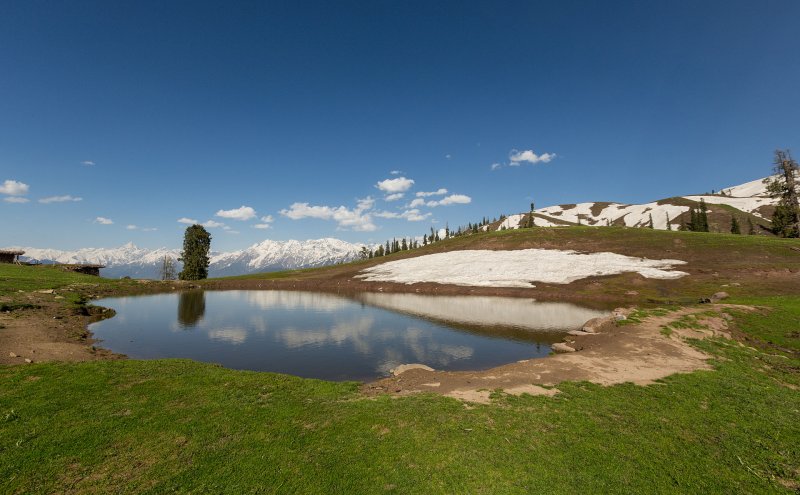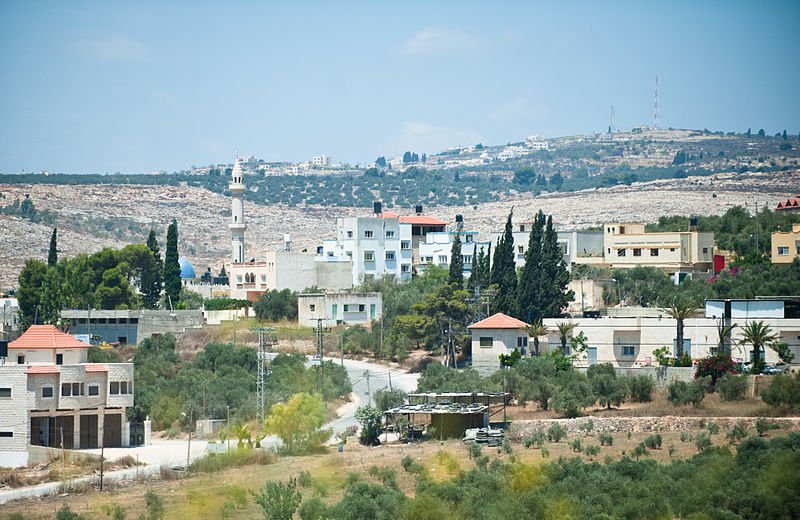
The landscape along the Mekong north of Luang Prabang.
The Mekong River is the 12th longest river in the world and the 10th biggest in terms of volume. It is approximately 4180 km long. It has a tremendous affect on the lifelihood of millions who dwell along its banks.
The Mekong River has its source in the frigid Jifu Mountains in Tibet, about 5200 meters above sea level. Approximately half of its total length is in China, where it is called Dza Chu in Tibetan, along its upper course, and Lancang in Chinese. The Chinese also call its entire stretch the Meigong.
From China, the Mekong flows into Myanmar and Laos, where it forms the border between these two countries for 200km before reaching the Golden Triangle, at the border with Thailand, which is where the Ruak River flows into it. The Golden Triangle separates Upper Mekong from Lower Mekong.
Leaving behind Myanmar, the Mekong is the natural boundary between Laos and Thailand, before entering Laos. In both countries, it is known as Menam Khong, which means, the mother of all rivers. It flows through gorges which widens as the river approaches Luang Prabang.
The Mekong once again forms the border between Thailand and Laos where is passes the city of Vientiane. After that it reverts into Laos again, before entering Cambodia.
The Mekong is also known as Tonle Thom, or Great River, in Cambodia. The city of Phnom Penh is located at the confluence of the Mekong and its main Cambodian tributary, the Sap River, which flows out of the great Tonle Sap lake. The Mekong has such a huge impact on the Sap River that every year in spring, the melting winter snow reverses the flow of the Tonle Sap River to empty into the great Tonle Sap Lake.
Beyond Phnom Penh, the Mekong folks into two. The smaller of the two is the Bassac River. Both the Bassac and the Mekong proper eventually flows into the Mekong delta, which empties into the South China Sea.
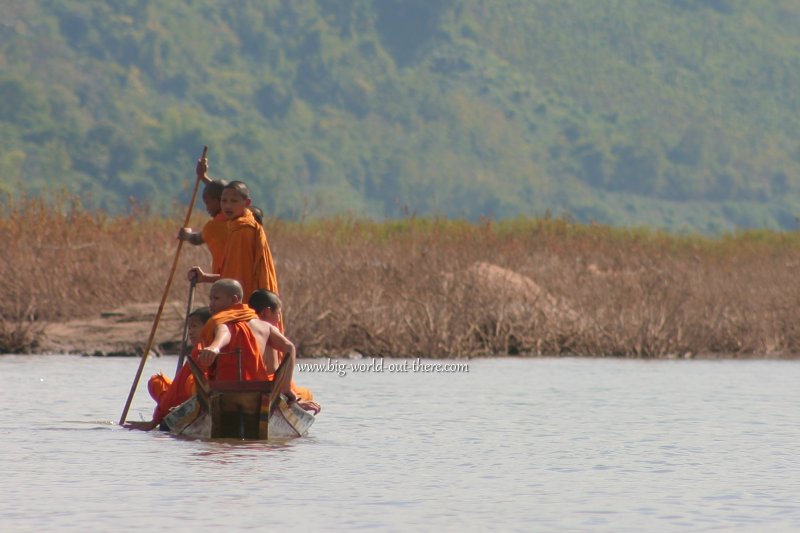
Buddhist novices crossing the Mekong on a canoe.
The Mekong at the Golden Triangle. Thailand is in the foreground while Myanmar is on the opposite bank. The river on the left is the Ruak River, a tributary of the Mekong.
Fishermen drawing in their net on the Mekong, near Pak Ou Caves in Laos.
Thrill-seekers speeding down the Mekong towards Luang Prabang.
Sunset casts a crimson silhoulette over Mount Phousi at Luang Prabang
Seen from the top of Mount Phousi, the Mekong is a quicksilver ribbon beside Wat Mai Suwannaphumaham in Luang Prabang
Riverboats at the ready on the Mekong in the early morning.
Houseboats emerge from the morning mist on the Mekong.
Diners at a Mekong riverside eatery in Vientiane.
The confluence of the Mekong (background) and the Sap River (foreground) in Phnom Penh.
Thank you, thank you, thank you, for the opportunity to explore the world, to document, to photograph, and to share the information with you. My name is Tim, I'm the writer of this website, and I want to tell you how grateful I am for your visit. This is one of over a dozen websites that I write - you can click my thumbnail photo above to randomly visit any one of them. All my photos are available for commercial printing - find out the photo usage rights here. If you wish to share you photos on this website, upload them to www.panoramio.com and send the URL to me for consideration. And, if you'd like to correspond with me, send your mails to my address as shown below:
About the Author: AsiaExplorers is researched and written by Timothy Tye. We take reasonable care to check and verify the accuracy of the content. However, we disclaim any responsibility for any inconvenience, mishap, injury or death resulting from following the advice provided directly or indirectly by AsiaExplorers and the comments on its pages. All the photographs in AsiaExplorers are available for publication. Please contact AsiaExplorers at the following email address for your enquiries: