World Travel GuidesHistory of Malaysia


Exotic Tours of Asia
 Asia Travel Guide Compare Hotel Room Rates from different Booking Sites     Follow Me on Pinterest 
Prehistoric tools from various excavation sites
Prehistoric tools from various excavation sites, Lenggong Museum of Archaeology, Perak (1 April 2006)
© Timothy Tye using this photo


The land where Malaysia is located has been inhabited since prehistoric times. Archaeological discoveries in places such as Lenggong in Perak and Niah Caves in Sarawak pointed to human habitation dating at least 5000 years ago. Kota Gelanggi in Johor is said to be the site of the first capital of the Srivijaya empire around 650-900 AD. In Lembah Bujang, Kedah, are remains of Hindu candis, or temples, dating to the early 5th century. The oldest state in Malaysia, Kedah, is said to trace its origin from the Hindu-Buddhist settlement in that area.
The recorded history of Malaysia is generally accepted to begin with the establishment of Malacca by Parameswara, a prince from Palembang of the Srivijaya empire. Political instability forced him to flee Palembang. Parameswara is said to have landed in Temasek and passed theough Muar before finally at the site on the south bank of the Malacca river. A Hindu at birth, Parameswara is said to have converted to Islam when he took a princess from Pasai as his consort, and titled himself Sultan Iskandar Shah. The subsequent rulers of Malacca took on the title "Shah".
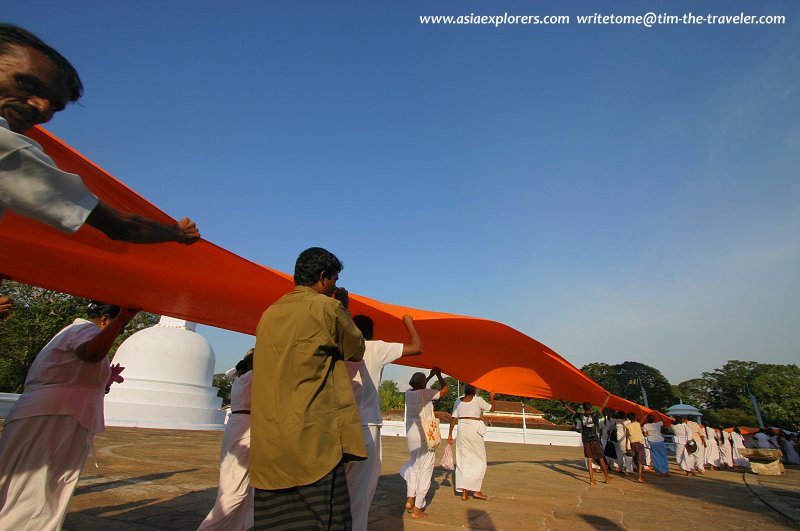
The dynasty started by Parameswara, commonly known as the Malacca Sultanate, began around 1400 and lasted until 1511, when it was brought down by the Portuguese. Ejected from the state, two of the sons of the last sultan of Malacca established the Sultanate of Perak and the Sultanate of Johor respectively.

The Dutch replaced the Portuguese as the second European colonial power. This happened in 1641 following a six-month siege of the Malacca Fort. Like the Portuguese before them, the influence of the Dutch was limited to Malacca, despite repeated attempts to control the trade along the Straits of Malacca, as well as the export of tin and other commodities.

Istana Kenangan, Kuala Kangsar
Istana Kenangan, Kuala Kangsar (31 January 2006)
© Timothy Tye
The founding of a British trading port on Penang in 1786 was the start of British influence that grew to control the whole country (at that time, the country itself did not yet exist - Malaya, as it was known from the mid-19th century onwards, was composed of individual states ruled by their own sultans). The Anglo-Dutch Treaty of 1824 divided the Malay world between the Dutch and the British, with the lattar taking control of the Malay peninsula. While the Malay states were ruled by sultans, the British established a crown colony of its four possessions, Penang, Malacca, Singapore and Victoria (now Labuan), collectively known as the Straits Settlements. British influence in Malaya were limited to these possessions until the Pangkor Treaty of 1874, which paved the way for British influence to penetrate the rest of Malaya.

On the island of Borneo, the present state of Sabah was ruled by the British as a crown colony, called British North Borneo, while the state of Sarawak was ruled by the Brooke family, who acquired it from the Sultanate of Brunei, ruling it as a personal kingdom.

The Japanese Occupation of the country during World War II changed the political equation forever. Following the war, the British returned to an entirely different country, one that is determined to gain independence from colonial rule.

Christ Church, Malacca
Christ Church, Malacca (9 July 2005)
© Timothy Tye
The initial plan by the British to administer the entire country as a crown colony, to be known as the Malayan Union, was rejected by the Malays. Malayan Union lasted less than two years, from 1946 to 1948, when it was replaced by the Federation of Malay. Between 1948 and 1960, the country was preoccupied with fighting communism, which under the leadership of the Malayan Communist Party, was threatening to bring down the government to establish a communist state. This was achieved by uprooting the largely Chinese communities living in the rural areas and resettling them in guarded communist-free villages known as Kampung Baru or New Villages.

The country gained independence from the British on 31 August, 1957, and became a member of the British Commonwealth. It was then known as Malaya. In 1963, the other British crown colonies of Sabah, Sarawak and Singapore joined Malaya to form Malaysia. The Sultanate of Brunei, which initially also intended to join the federation, withdrew following opposition within its population. The formation of Malaysia was opposed by Indonesia and the Philippines. Armed conflict flared between Malaysia and Indonesia, known as Konfrontasi. Racial strife ejected Singapore from the federation in 1965. Another race riot that erupted on 13 May 1969 following the victory of the opposition party in a general election brought along the controversial New Economic Policy, a social reengineering programme to redistribute wealth among the races.

Malaysia experience enviable economic growth from the 1980s to the mid 1990s, under the leadership of Mahathir Mohamad. The new-found wealth enabled the construction of several mega projects including the Petronas Twin Towers, the Kuala Lumpur International Airport and Putrajaya, the new federal administrative capital.

The current and sixth prime minister of Malaysia is Mohd Najib Tun Razak, who took over the helm from Abdullah Ahmad Badawi on 3 April 2009. Malaysia practices a unique form of monarchy where the federal head of state, usually called the king, is elected to a five-year term among the nine hereditary sultans of the Malay states.

Return to Malaysia Travel Guide

Hotel Room Price Checker


Before booking a hotel room, make sure you are getting the lowest price for it. Different hotel booking websites offers the same room at different prices. If you stick with one site all the time, you could be paying more for the same room. Now why pay more?

The form below is a Research Engine. It doesn't take bookings. Instead it lets you find the hotel booking website that offers the room you want at the lowest price. You can see and compare what different sites are offering, and then click to choose the one with the best price. Do this, and you're guaranteed to save a whole lot of money on your room reservations!


Join an AsiaExplorers Tour!

AsiaExplorers, in partnership with Exotissimo Travel, brings you exotic tours of Asia. Join us to experience Vietnam, Cambodia, Laos, Thailand, Myanmar and Indonesia. Now you have the opportunity to go to these places and see for yourself the sights you read on this page. Tell us where you would like to go, and what you love doing when traveling.

In order for us to process your inquiries, complete the Travel Inquiry Form, submit it, and we will get back to you as soon as possible. Travel Inquiry Form

Look for Flights, Tour Packages and Car Rentals

Find the best airfare, tour packages and car rentals for the destination you are visiting. Just click the Travel Search button below and my search engine will search the whole Internet to show you what's available.

Point - Click - Discover!

Thanks for visiting this webpage. To continue exploring, choose another destination!


My World Travel Guides - celebrating a beautiful world beautifully.

I've been writing my travel websites since 2003. The general sites include Asia Travel Guide, Earth Travel Guide, UNESCO World Heritage Sites, World Greatest Sites and my World Travel Guides. I have a city-based series that includes Angkor, Bali, Bangkok, Chiang Mai, Hanoi, Kuala Lumpur, London, Luang Prabang, Macau, Malacca, New York, Paris, Penang, Phuket, Singapore, Sydney, Tokyo and Venice. I also have a country-wide series that includes Australia, Britain, China, Egypt, France, Germany, Greece, India, Italy, Japan, Malaysia, Mexico, Netherlands, New Zealand, Portugal, Spain, Sweden, Turkey and the United States of America. I hope you will enjoy my sites as much as I enjoy bringing them to you.

Bookmark and Share


Logo Copyright © 2003-2011 Timothy Tye. Text available under Creative Commons Attribution/Share-Alike License 3.0 (Unported)
Terms & Condition of Use | Privacy Policy