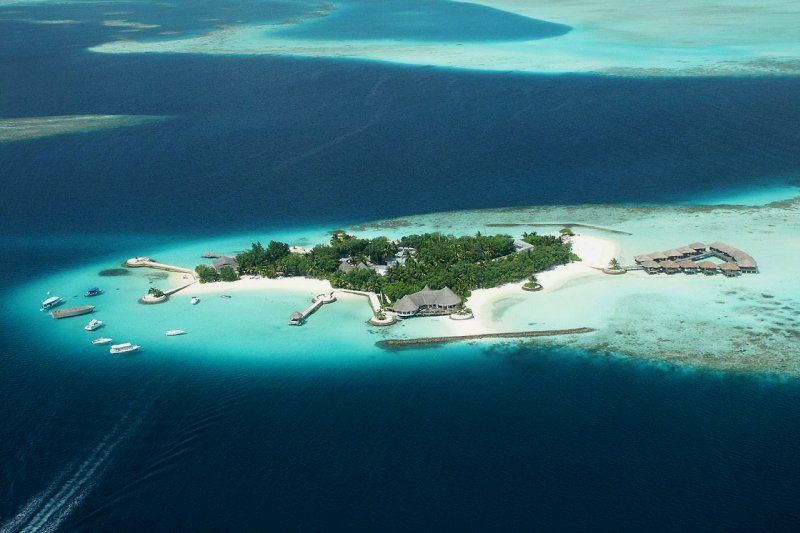
Kedah is a state on the northwestern part of Malaysia. Covering 9,425 sq km, much of Kedah is flat land suitable for rice cultivation. There are a few off lying islands along the Kedah shore, the most important being the Langkawi archipelago.
The capital of Kedah is Alor Setar, while the second biggest town is Sungai Petani. Kedah is divided into 11 districts namely Baling, Bandar Baharu, Kota Setar, Kuala Muda, Kubang Pasu, Kulim, Pulau Langkawi, Padang Terap, Pendang, Sik and Yan. The official name of the state is Kedah Darul Aman, where the Arabic honorific means Abode of Peace.
Flooded rice fields are characteristic of the landscape in Kedah.
History of Kedah
The history of Kedah can be traced to the 4th Century AD, with the Hindu-Buddhist civilization of Bujang Valley (Lembah Bujang, http://www.asiaexplorers.com/malaysia/kedah/lembahbujang.htm). This is the oldest civilization in Peninsular Malaysia. The current Kedah royal family traces its lineage to this time. According to Hikayat Merong Mahawangsa or the Kedah Annals, Kedah was founded by a Hindu king named Merong Mahawangsa. Kedah became a sultanate in 1136 when the 9th ruler of Kedah, Phra Ong Mahawangsa (1136-1179) converted into Islam and took the title of Sultan Mudzafar Shah. The present Sultan of Kedah is Tuanku Abdul Halim Muadzam Shah, who was coronated in 1958 as the 27th sultan of Kedah.
Throughout its history, Kedah suffered from its close proximity to its mightier northern neighbour, Siam. In the 7th and 8th Centuries, Kedah was under the domination of the Srivijaya Empire. It was then a vassal of Siam until the rise of the Malay sultanate of Malacca, http://www.asiaexplorers.com/malaysia/malacca.shtml in the 15th century. In the 17th century, Kedah was attacked by the Portuguese after their conquest of Malacca, and by Aceh.
Hoping that the British would protect it from Siam, the Sultan of Kedah handed over Penang and then Province Wellesley at the end of the 18th century. It was a deal made by Francis Light which was not honoured by his superiors, and in 1821, the Siamese still conquered Kedah. Kedah remained under Siamese control until it was transferred to the British through the Anglo-Siamese Treaty of 1909.
In World War II, Kedah (along with Kelantan) was the first part of Malaya to be invaded by Japan. The Japanese returned Kedah to their Siamese allies and renamed it Syburi. However, at the end of the war, Kedah returned to British rule and was a reluctant addition to the Federation of Malaya in 1948.
Point-and-Click Map of Kedah
The underlined sites are linked to specific pages.
AsiaExplorers is researched and written by Timothy Tye. Reasonable care is taken to check and verify the accuracy of the content. AsiaExplorers disclaims responsibility for any inconvenience, mishap, injury or death resulting from following the tips and advice provided directly or indirectly by this website. All pages may be printed out for your own personal, non-commercial use. Photographs not credited to a third party belong to Timothy Tye and may not be reused in any form unless you are first given permission. Write in to inquire if interested. Third party photographs are governed by their respective licenses. The author is a Christian. Click here if you are interested to know more about his Christian beliefs. To contact AsiaExplorers, use the following email address: