This sight is located in Perak, Malaysia. Your base to visit it is Ipoh, the capital of Perak. Read the Ipoh for useful information about Ipoh. For more background about Perak, read Perak. To prepare for a trip to Malaysia, read also Malaysia. Looking for accommodation? Find good, clean rooms at Budget Accommodation Guide
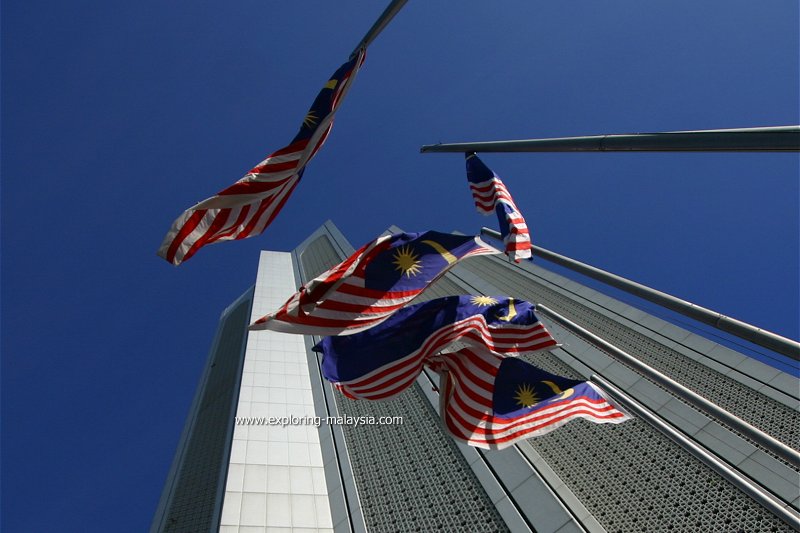
View of Leaning Tower of Teluk Intan, festooned with flags for Merdeka Day celebrations.
The Leaning Tower of Teluk Intan is one of the most curious landmarks in Perak, and perhaps in the whole Malaysia as well. For over a hundred years this grandfather of towers squarts on the edge of Jalan Selat next to Jalan Pasar. When it was built in 1885, it was known as the High Clock Tower because of the clock on it that is still working right to this day. But as it starts to tilt towards the northwest, it gained notoriety as the most famous leaning tower this side of the world.
The tower is 85ft (25.5m) high. There are 110 steps connecting the floors which are 15.5 feet high. The base of the structure is 43 feet in diameter.
Take a close look at the tower, and you will find distinctly Chinese architectural elements in the design, especially the use of mortar strips, roof eves and drippers. It wasn't surprising therefore that the man responsible for putting up the tower was a Chinese, a contractor by the name of Leong Choon Chong.
Leong's actual purpose was to put up a water storage tower, a necessity in the event of draughts, as well as to serve the town in the event of fire, considering the town did not have a fire brigade at that time. The choice of site, however, was not at all ideal for a heavy tower. The problem was further aggravated by two major floods in 1889 and 1895 that submerged the base of the tower.
Throughout the long history of the tower, it has served different purposes. During the Japanese occupation, for example, it was used as a watch tower.
Realising the heritage value of this leaning tower, the Hilir Perak District Council in 1997 constructed a plaza around (a mistake, in my opinion, for it also scrubbed much of the quaintness surrounding the tower). The council also undertook restoration work to halt further lean to the tower. It was closed to the public during restoration, and was only reopened in the middle of 2004. I visited among the first few to visit it after it opened.
The entrance to the Leaning Tower of Teluk Intan.
Let's go explore upstairs ...
Here we are on one of the upper floors. Notice the Chinese elements in the design of the balustrades.
Another Chinese element in the design, as seen in the mortar strips, eves and drippers. By the way, I visited on September 21. It seems that they still haven't removed the flags put up for the August 31 National Day celebrations.
Close-up view of the Leaning Tower of Teluk Intan.
Before booking a hotel room, make sure you are getting the lowest price for it. Different hotel booking websites offers the same room at different prices. If you stick with one site all the time, you could be paying more for the same room. Now why pay more?
The form below is a Research Engine. It doesn't take bookings. Instead it lets you find the hotel booking website that offers the room you want at the lowest price. You can see and compare what different sites are offering, and then click to choose the one with the best price. Do this, and you're guaranteed to save a whole lot of money on your room reservations!
If you're flying somewhere, use our Flight Checker to compare the rates from different airlines. To use it, enter where you will be flying from, where you will be flying to, your departure date and return date. Select the number of passengers, and then click search.
Our engine will return you a list of possible flights that you can take. You can compare the fare of different airlines for your trip. Click on your selected airline, and we transfer you to the airline website.
AsiaExplorers is researched and written by Timothy Tye. Reasonable care is taken to check and verify the accuracy of the content. AsiaExplorers disclaims responsibility for any inconvenience, mishap, injury or death resulting from following the tips and advice provided directly or indirectly by this website. All pages may be printed out for your own personal, non-commercial use. You may use the information on this website on your blog or website so long as you place a dofollow link back to the page in AsiaExplorers where it appears. Photographs not credited to a third party belong to Timothy Tye and may not be reused in any form unless you are first given permission. Write in to inquire if interested. Third party photographs are governed by their respective licenses. To contact Tim, write to the following email address: