Penang Tourist Attractions
Penang, the Pearl of the Orient
Penang may be one of the smallest state in Malaysia, but it is endowed with an enormous variety of attractions, making it one of the major tourist destinations in the country. In the AsiaExplorers Penang Travel Guide, we get to know this beautiful state off the coast of Malaysia.
Penang consists of two parts: Penang Island and Seberang Perai. Penang Island is 293 square kilometers while Seberang Perai, also known as Province Wellesley, is 760 square kilometers. The metropolitan area of Penang stretches from George Town southwards to Bayan Lepas, and on the Seberang Perai side, from Butterworth down to Seberang Jaya. George Town is a city steep in history and heritage, with lots of photography opportunities. Some of the loveliest beaches in Penang are found along the north coast of Penang Island, between Tanjung Tokong and Teluk Bahang.
 Pagoda of 10,000 Buddhas, Kek Lok Si Temple, Ayer Itam, Penang.
Penang Hill, also known as Bukit Bendera, is a collection of hills on the central portion of Penang, with the highest peak being Western Hill, at 830 meters above sea level. With 2032 persons per square kilometer on Penang Island and 866 persons per square kilometer in Seberang Perai, Penang is the most densely populated state in Malaysia. 66% of the population is Chinese (1995), 23% Malay and 11% Indian.
Brief History of Penang
Penang was founded in 1786 when the Sultan of Kedah handed it over to the British East India Company, in return for a promise to protect it from invasion by Siamese and Burmese forces. Captain Francis Light was looking for a base to be used as a British trading post. He explored different places including Phuket before settling on Penang. On 11 August 1786, Francis Light landed on Penang and named it Prince of Wales Island.
The location of Penang at the mouth of the Straits of Malacca makes it an attractive choice for a British outpost. It has a natural harbour for trading ships and can be developed into a naval base to counter a growing French ambition in the region. Francis Light named the settlement at the northeastern tip of Penang as George Town, after King George III (1738-1820).
When handing Penang over to Francis Light, the Sultan of Kedah was unaware that Light was acting without the approval of his superiors to offer military protection. When it became clear that the British had no intention of protecting Kedah from Siam, the Sultan of Kedah tried to retake Penang in 1790. The attempt was unsuccessful, and the Sultan was forced to cede Penang to the East India Company for an honorarium of 6000 Spanish dollars per annum. When Province Wellesley was added to Penang in 1800, this amount was increased to 10,000 Spanish dollars. The Malaysian government continues to pay this annual honorarium of 10,000 ringgit to the state of Kedah. In 1821, Siamese forces conquered Kedah and it remained under Siamese control until it was transferred to the British by the Anglo-Siamese Treaty of 1909.
In 1826, Penang, along with Malacca and Singapore, became part of the Straits Settlements under the British administration from India. From 1867, it came under direct British colonial rule. In 1946, after the end of World War II, Penang became part of the Malayan Union, before becoming a state of the Federation of Malaya in 1948. In 1963 Penang became one of the 13 states of Malaysia.
George Town was accorded city status by Queen Elizabeth II on January 1, 1957. This makes it the first town in the then Federation of Malaya to become a city, after Singapore. Still on display at the Penang State Museum is the royal charter granting George Town its city status and the petition from the Penang residents to Queen Elizabeth II in this regard. However, as a result of local government reorganisations in 1976, the City Council of George Town was merged with the neighbouring Penang Rural District Council to form the Municipal Council of Penang Island (Majlis Perbandaran Pulau Pinang). Although the city status of George Town was never officially revoked, the state and federal governments are of the view that it has ceased to exist. In recent years, local resentment has grown as relatively insignificant towns such as Alor Setar have been designated cities. The state government has announced its intention to petition the Yang di-Pertuan Agong (King) of Malaysia for a regrant of city status once the city's new boundaries are agreed.
The island was a free port until 1969. Since the 1970s, Penang has built up one of the largest electronics manufacturing bases in Asia, in the Free Trade Zone around the airport in the south of the island. Its colonial history and Penang’s awareness of its past legacy, many buildings of colonial times can still be seen today. Such buildings include the City Hall, the Town Hall, the Eastern & Oriental Hotel, the Old Court House, Suffolk House (Francis Light’s residence), Uplands International School building, Standard Chartered Bank building and the HSBC Bank building. Local conservation groups such at the Penang Heritage Trust are lobbying the Penang state government to restore many of Penang's historical buildings but sadly a number of them have dilapidated beyond repair.
Directory of Penang Listings
Preparing for Penang
Arriving in Penang
Staying in Penang
While in Penang
Penang Food
Life in Penang
Travel Store
Leaving Penang
|
Penang Photo Gallery

Above: Wat Chaiyamangkalaram, Burmah Lane, is noted for its huge reclining Buddha statue.
|

Above left: Chien nien broken pottery figurines at the rooftop of the Teochew Association Ancestral Temple reflects Penang's cultural heritage. | 
Above: View of Burmah Road with the old Loke Thye Kee Restaurant, a heritage structure now abandoned to the elements, another Penang example of urban decay. |
|

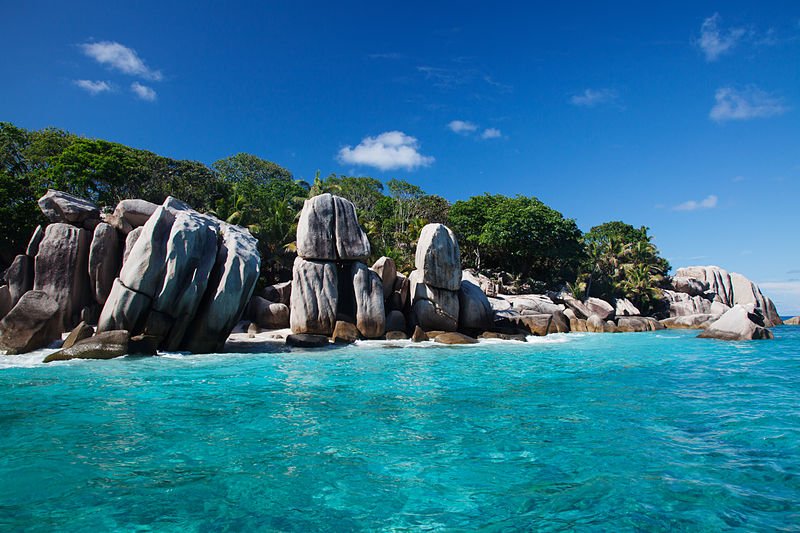
Above: The Penang City Hall is a legacy of its colonial past. The Penang Clock Tower was erected in honour of the Diamond Jubilee of Queen Victoria. Below: The natural rock formations of Pulau Kendi is one of the wonderful secrets of Penang waiting to be discovered. |  |
|
|