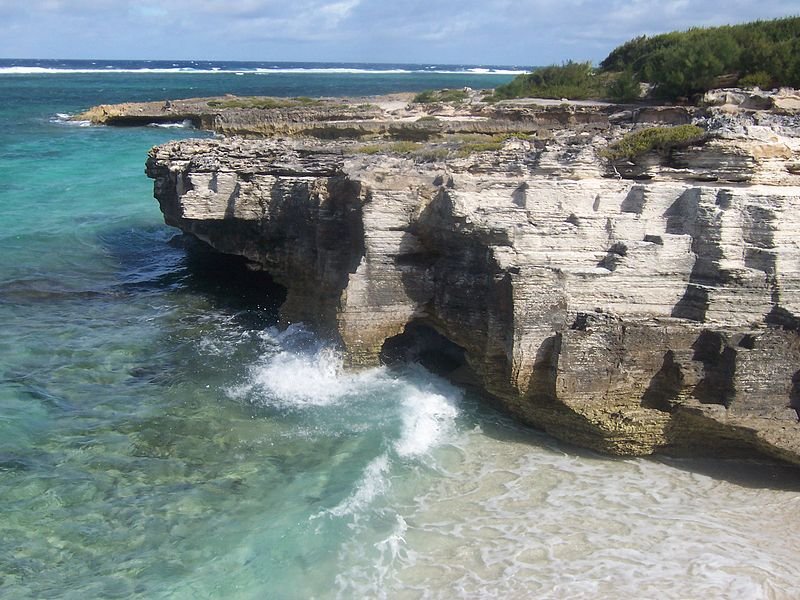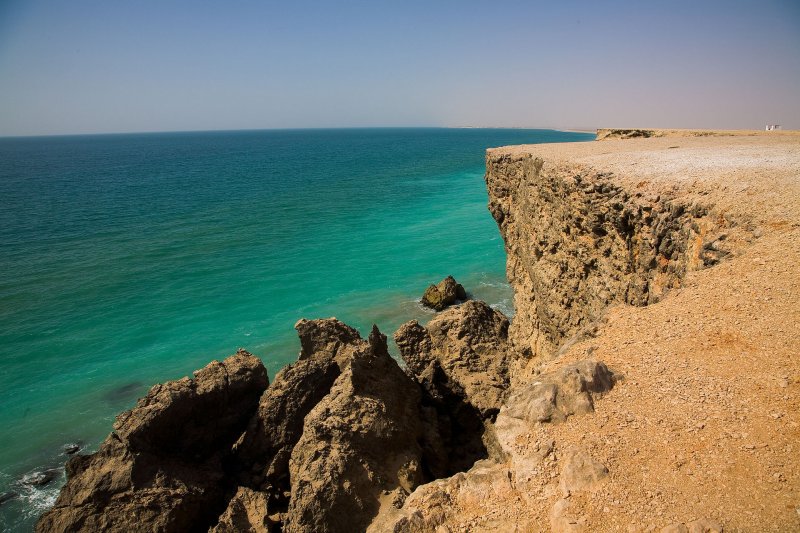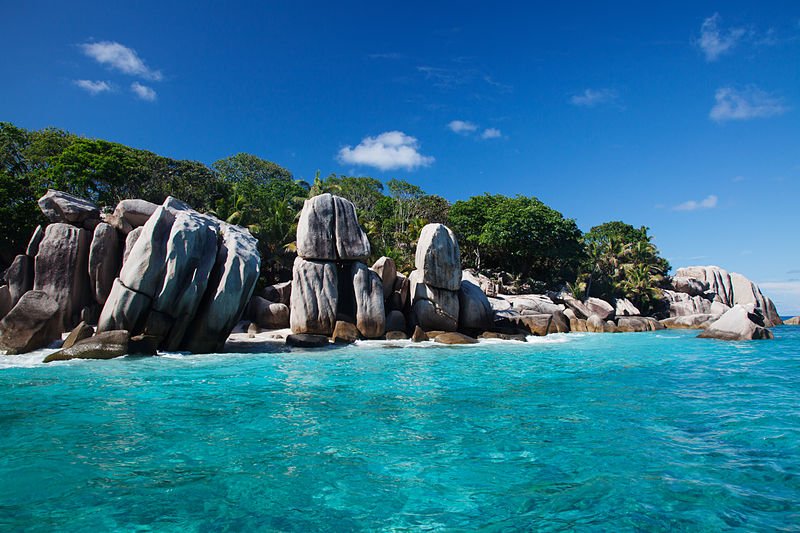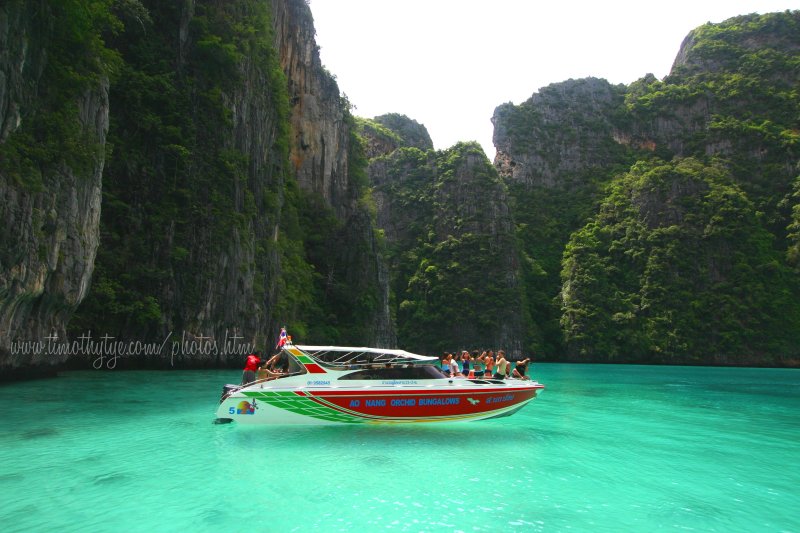
Pulau Kendi, on the southwestern tip of Penang island, off Gertak Sanggul, holds the distinction as the only place left in Penang with water so clear you can still see the rocks on the sea bed. And it's the only place left where you can still swim the sea without fear of a jellyfish attack.
Rocky coastline of Pulau Kendi.
The word "kendi" means flask in Malay, and the name comes from the shape of Pulau Kendi. Approaching Pulau Kendi from Gertak Sanggul, you will see the resemblance of a gargantuan flask lying on its size in the sea. No wonder Pulau Kendi is known in Hokkien as Hor Lor Su, Flask Island.
Long known to fishermen as well as anglers as the drop-off point before the open sea, Pulau Kendi was left largely unnoticed until recently, when reports appeared in the media that there are plans of turning it into a tourist destination.
Fearful that wanton development will wash onto its rocky shores, AsiaExplorers made a couple of trips to Pulau Kendi to ascertain its tourist potential, and to recommend how the beauty of Pulau Kendi can best be appreciated and tapped.
We found a scabrous outcrop in the midst of an emerald green sea. A beautiful island, densely forested, Pulau Kendi surrounds itself with rock formations of incredible variety and beauty. They come in a glorious selection of shapes, hues and sizes.
Relentlessly battered by the raging sea, they bear the natural signs of wear. As slippery as polished marble, and as sharp as razor, these rocks - which run the gamut from magma to sedimentary rocks to hard granite - are the sentinels that have kept the island well protected, and prevented all but the most hardy from ever landing here.
The hills are steep and clad with a healthy growth of vegetation, making exploration a rather challenging experience. The only sandy stretch of beach was no more than 100 feet in length. That was where we landed and picnicked. From there, we cut our way up the hill, crossed to the other side. There was a team of anglers perched precariously on the jagged outcrops between the water line.
On the steepest slope at the most hidden crevice, we found a cliffside adorned with scores of tiny idols. There was Kuan Yin, the goddess of mercy, as well as a plethora of deities, statues no taller than one foot. They guard, they watch over the open sea, while the waves blast on the rocks below. We could only speculate who have placed them there.
Although the island was uninhabited, we found signs of civilization in abundance, all over the place, in the form on inorganic refuse. The entire beach front was littered with plastic bottles, wrappers, tyre tubes.
It appears that the island is being used as a convenient dumping ground. We were disheartened by this disrespect for nature and the environment, and that the people of Malaysia in general, and Penang in particular, could not lift themselves above the filthy habit of littering the land. We must say that this is the work of a small minority, but the result affects the well-being of the entire majority.
If Pulau Kendi is to be recognised as a tourist destination, the first and most important item on the agenda should be a clean-up of the island. All inorganic refuse must be cleared. Footpaths can be cleared to traverse the island, taking visitors to specific look-out points. In the seas, fish fry, and planktons should be released to improve on the variety as well as quantity of fishlife. The corals should be breed. Angling should be controlled and licensed. Commercial fishing should be barred from approaching anywhere closer than three hundred metres from the island. Only environmentally conscious organisations such as AsiaExplorers should be allowed to bring visitors to Pulau Kendi, and a fee should be charged which will be used for the upkeep and maintenance of the island. AsiaExplorers further recommends that the caretaker, in the form of a forest ranger, should be authorised to issue summons to whoever is caught littering the island.
AsiaExplorers recommends that there should be no construction of any structures on the island, except for a caretaker's abode. Certainly no chalets here please. There should be no cement brought, as this will pollute the sea. No pier should be built. The only access should be by boat. It should remain a place where the environmentally conscious can come to appreciate the nearness to nature, in a pristine surrounding.
This is the most pristine part of Penang, the only pristine one remaining. If you ever consider visiting it, we urge you to keep it clean. It will be worth your effort.
Pulau Kendi Map
Map of Penang showing Pulau Kendi.
Pulau Kendi Photo Gallery
AsiaExplorers members on the way to Pulau Kendi.
The coastline of Pulau Kendi is characterised by rocky cliffs.
Moonscape rock formation in Pulau Kendi.
Rock formation like an ancient calligraphic text at Pulau Kendi.
Barnacles form a rock pattern, Pulau Kendi.
Rock in the form of brain coral, Pulau Kendi.
These are not pebbles, but snails. Early morning at Pulau Kendi.
Rocks in the form of solid waves on the Pulau Kendi shore.
Shellfish cling tenaciously at the surging tide.
Fan-shaped rocks at Pulau Kendi.
Chinese deities left on the rocky ledges of Pulau Kendi.
Timothy Tye, founder of AsiaExplorers, on the way to Pulau Kendi.
Penang Overview
Get to know Penang and explore its many fascinating sights!
Penang Travel Tips
A new website created to provide travel tips to people planning a visit to Penang!
Penang Travel Map
Detail map pointing out all the tourist attractions in Penang!
There are a number of small islands surrounding Penang Island. Only Pulau Jerejak and Pulau Aman has any form of habitation, while the rest are mere outcrops in the sea. Click enter to view them.
Thank you, thank you, thank you, for the opportunity to explore the world, to document, to photograph, and to share the information with you. My name is Tim, I'm the writer of this website, and I want to tell you how grateful I am for your visit. This is one of over a dozen websites that I write - you can click my thumbnail photo above to randomly visit any one of them. All my photos are available for commercial printing - find out the photo usage rights here. If you wish to share you photos on this website, upload them to www.panoramio.com and send the URL to me for consideration. And, if you'd like to correspond with me, send your mails to my address as shown below:
About the Author: AsiaExplorers is researched and written by Timothy Tye. We take reasonable care to check and verify the accuracy of the content. However, we disclaim any responsibility for any inconvenience, mishap, injury or death resulting from following the advice provided directly or indirectly by AsiaExplorers and the comments on its pages. All the photographs in AsiaExplorers are available for publication. Please contact AsiaExplorers at the following email address for your enquiries: