Explore a different destination Bago (Pegu), Myanmar


    Myanmar Asia Earth World Greatest Sites   Advertise on this page  Bookmark and Share

Bago Tourist Attractions

Htaukkyant Cemetery
Htaukkyant Cemetery
Kanbawzathadi Palace
Kyaikpun Pagoda
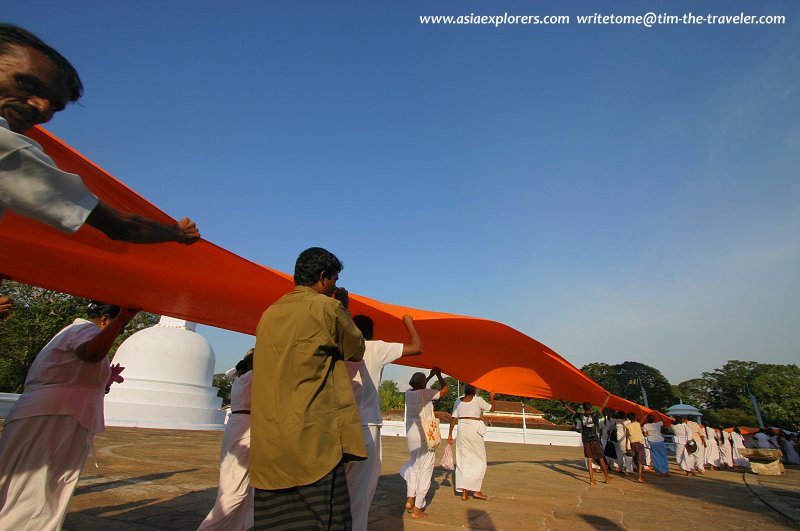
Kyaikpun Pagoda
Kyatkatwine Teaching Monastery
Shwemawdaw Pagoda
Shwemawdaw Pagoda
Shwethalyaung Buddha

Bago, ancient Mon capital

Kanbawzathadi Palace
© Timothy Tye (21 November 2003)

Hawker selling local banana cake
© Timothy Tye (21 November 2003)

Vendors selling sandalwood vans, Bago
© Timothy Tye (21 November 2003)

Bago, formerly Pegu, is the ancient capital of the Mon people of Burma. Today Bago is the capital of the Bago Division in present-day Myanmar. Bago is 80 km northeast of Yangon. At the time it was founded, Bago was a major port city, before the river changed its course. This, and the destruction of Bago by a rival Burmese king, sealed Bago's downfall.

According to legend, Bago was founded by two Mon princesses from Thaton in 573 AD. They had seen a female goose standing on the back of a male goose on an island in a huge lake. Considering that to be an auspicious omen, they built a city called Hanthawady (Pali Hamsavati) on the edge of the lake.


Arab geographer Ibn Khudadhbin mentioned this city around 850 AD. By then, the Mon capital had shifted to Thaton. The area came under rule of the Burmese from Bagan in 1056, with the conquest of Thaton by King Anawrahta (see the page on Bagan). The Mon only regained their independence after Bagan collapsed under Mongol invasion in 1287.

Hanthawady was the capital of the Mon Kingdom of Ramanadesa from 1369-1539. Ramanadesa covered all of what is today Lower Myanmar. The Mon area came under Burman control again in 1539, when it was annexed by King Tabinshwethi to his Kingdom of Taungoo. The kings of Taungoo made Bago their royal capital from 1539-1599 and again in 1613-1634, and used it as a base for repeated invasions of Siam.

As a major seaport, Bago was frequently visited by Europeans. And then, in 1634, the Burmese capital relocated to Ava. In 1740, the Mon revolted and briefly regained their independence, but Burmese King Alaungpaya ransacked and completely destroyed Bago in 1757, and once again the Mon lost their independence.

King Bodawpaya who reigned from 1782-1819 rebuilt Bago, but by then the river had shifted course, cutting the city off from the sea. With that, Bago declined in importance. After the Second Anglo-Burmese War, the British annexed Bago in 1852. In 1862, the province of British Burma was formed, and the capital moved to Yangon.

The name Bago is spelt peh kou literally. The substantial differences between the colloquial and literary pronunciations, as in with Burmese words, was a reason of the British corruption "Pegu".

Getting there

The best way to see Bago, as a free independent traveler, is to hire a taxi from Yangon. You should pay about US$40-50 for the taxi, giving you the opportunity to explore the sights of Bago easily. On the way, you can also stop over at the Htaukkyant Cemetery.


Compare Hotel Room Rates

Find the lowest price of hotel rooms from different Hotel Booking websites. Our free Hotel Search Engine lets you compare room rates from different booking sites. Just key in your visiting City. You'd be glad to do your homework!


Copyright © 2003-2010 AsiaExplorers.  All rights reserved.

AsiaExplorers is researched and written by Timothy Tye. Reasonable care is taken to check and verify the accuracy of the content. AsiaExplorers disclaims responsibility for any inconvenience, mishap, injury or death resulting from following the tips and advice provided directly or indirectly by this website. All pages may be printed out for your own personal, non-commercial use. Photographs not credited to a third party belong to Timothy Tye and may not be reused in any form unless you are first given permission. Write in to inquire if interested. Third party photographs are governed by their respective licenses. The author is a Christian. Click here if you are interested to know more about his Christian beliefs. To contact AsiaExplorers, use the following email address: