Botataung Pagoda
Yangon (Rangoon), Myanmar


Your base for exploring this tourist attraction is the city of Yangon (@ Rangoon). For travel information about Yangon, go to Yangon Travel Guide. To prepare for a trip to Myanmar, read also the Myanmar Travel Guide. Looking for budget accommodation there? Use AsiaExplorers Budget Accommodation Guide, the no-frills website to cover your budget accommodation needs.


Botataung Pagoda commemorates the 1000 military offiers (bo for military officer, ta-taung for a thousand) that formed a guard of honour to welcome the landing in Burma of the relics of the Buddha brought over from India more than two thousand years ago nu eight Indian monks.


The Botataung Pagoda undergoing restoration.
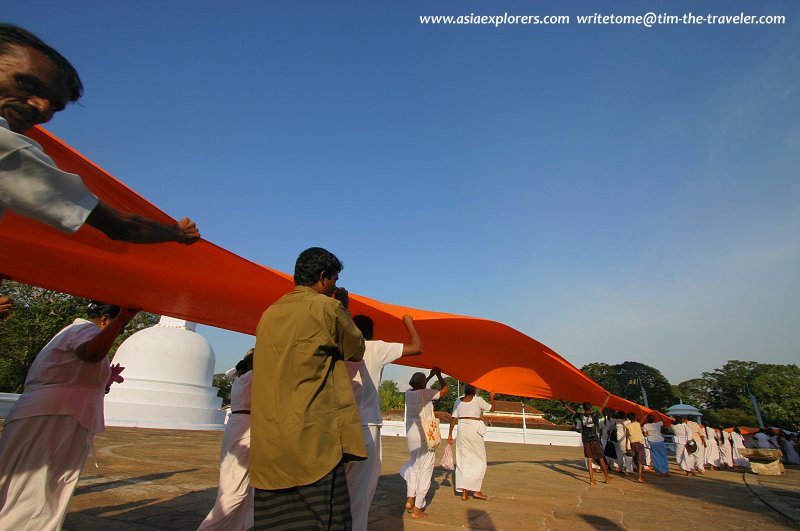

According to ancient chronicals, the Buddhist king Sihadipa gave one of his ministers a sacred hair of the Buddha and two body relics. This minister, renowned for his goodness and faith, consulted a famous religious leader and, on his advice, chose the Botataung Mount on the bank of Rangoon River at a distance of one thousand tars (7,000 cubits) in a South-Easterly direction from the Shwedagon Pagoda to enshrine the sacred relics. So the relics were buried here for the past two thousand years.

The Botataung Pagoda was a famous landmark on Rangoon's waterfront. Botataung is situated just below the long lines of jetties that serve the busy port where rice, petroleum, timber and mineral are shipped to the whole world. During the second world war, the pagoda was heavily damaged when the Royal Air Force bombed the nearby wharfs.

After the war, the duty to clear the ruins got underway. On the 4th of January, 1948, when regained her independence, the Rehabilitation Committee put in gold pegs as the first step towards actual reconstruction of the Botataung Pagoda.

Discovering of the Botataung Treasure Vault

After the driving in of the gold pegs the debris was cleared, and the precious items including gold and silver images, coins and ornaments, were recovered. At a depth of three feet an ancient chamber was uncovered. It was 20 ft by 20 ft and 6 ft in height, gradually decreasing in size towards the top to appear like a huge pot placed up-sided down to cover completely what lay inside.

In the centre of this treasure vault was a stone casket in the shape of a pagoda with a diameter of 23 ins, and 39 ins in height. Encircling this stone casket were figures of Nats (spirits or Minor Deities) carved out of laterite and evidently placed there to act as sentinels. The casket was immersed in mud as water had trickled into the vault during the many centuries it had been there.

Within this pagoda-shaped stone casket were various kinds of treasures: precious stones, ornaments, jewellery, terra-cotta plaques and images of gold, silver, brass and stone. The total number of these images recovered from the relic chamber was seven hundred. There were also terra cotta plaques, some of them in a fair state of preservation, depict Buddhist scenes.

One of the terra-cotta plaques bears an image of the Buddha. Although it had been affected by age and moisture, it was still exceptionally important. On the reverse side are inscribed characters which are very close to the ancient Brahmani script which came from Southern India. It is a precious evidence of ancient times and has been deciphered by U Lu Pe Win, the superintendent archaeologist, who pointed out that the initial word "e" from "evam vadi" shows that the script is in the manner of the ancient Mons. This is proof of the belief that the people who erected the Pagoda in ancient times were the Mons.

Botataung Stone Casket is opened

It was at once realised that the stone casket contained relics, but as this could not be opened unceremoniously, the pilgrims who had flocked here from all over Burma had to just imagine its contents. The Rehabilitation Committee met on several occasions but could not take the responsibility of opening the casket.


Henry, the AsiaExplorers tour guide for Myanmar, at Botataung Pagoda.
Then a meeting was called to which 15 of the leading religious leaders (Maha Theras) attended. At this meeting, on the advice of these Bhikkhus, that as an act prompted by good motives and religious faith it would be quite meritorious to open the casket, it was unanimously decided that it should be done in the presence of the members of the Committee and the public. Great precautions were taken so as not to cause the slightest damage. Actually, the cone was removed from the stone salver on which it stood without any difficulty. When this cone or stone layer was removed there was found inside another stone layer of similar shape but with a brilliant gold coating and this was more representative of a pagoda in shape while its exquisite workmanship and brilliance inspired feelings of deep religious fervour in the crowd present. Some mud had penetrated even here and the sides of the base were covered with this. When it was washed and sifted, precious stones, gold and jewellery were discovered round the base. This second stone casket was then removed and inside was found a small pagoda of pure gold standing on a silver salver or base and beside this golden pagoda was a carved stone image 4 1/2 inches high of very ancient workmanship.

When the gold Pagoda was lifted up, a tiny gold cylinder of 3/4 inches in length with a diameter of 5/12 inches was found, and in this tiny cylinder were found two small body relics each the size of a mustard seed and a Sacred Hair of the Buddha. This hair was coiled round and fastened with a little acquer on which were traces of gold plaster.

The body and hair relics of the Buddha, along with all the images and other precious objects recovered from the ruins of the Botataung Pagoda were temporarily stored in a shelter near the site of the Pagoda. Meanwhile the building of a new pagoda got underway. The new pagoda follows the original design and has a height of 131 ft. 8 ins, with a base of 96 ft. by 96 ft. The pagoda is built of reinforced concrete and is to be gilded. It was decided that the pagoda was to be completed before the Sixth Buddhist Synod which was to be held in Burma in 1954.

Unlike many of the older shrines, the Botataung Pagoda does not have a solid core but has a huge internal cavity where worshippers may enter.


Yangon

Exploring the Sights in Yangon

Yangon, previously known as Rangoon, was the capital of Myanmar until a few years ago. It continues to be the commercial hub of Myanmar. Click enter to view the sights there.


Yangon tourist attractions


Expedia.com

Click here to return to the AsiaExplorers Homepage

How much have you explored Myanmar? Through AsiaExplorers, you can now explore these places in Myanmar from the comfort of your desk: Myanmar, People of Myanmar, Myanmar History, Bagan (Ananda Temple, Bagan Plains, Dhammayangyi Pahto, Gawdawpalin Temple, Htilominlo Pahto, Kyanzittha Cave, Manuha Temple, Mingalazedi, Nanpaya Temple, Nyaung U Market, Shwesandaw Temple, Shwezigon Temple, Tharabar Gate, Thatbyinnyu Temple), Bago (Htaukkyant World War II Cemetery, Kanbawzathadi Golden Palace, Kyaikpun Pagoda, Shwemawdaw Paya, Shwethalyaung Buddha), Inle Lake (Kalaw, Nga Phe Kyaung Monastery, Padaung People, Phaung Daw U Pagoda, Shwe Yaunghwe Kyaung Monastery, Ywama), Kyaiktiyo, Pagoda of the Golden Rock, Mandalay (Amarapura, Mahagandhayon Monastery, U Bein Bridge, Atumashi Monastery, Ayeyarwady River, Inwa Bridge, Kuthodaw Paya, Maha Myat Muni Paya, Mandalay Hill, Mandalay Palace, Shwenandaw Monastery), Mingun, (Mantara Gyi Pagoda, Mingun Bell, Myatheindan Pagoda), Mount Popa, (Popa Taungkalat), Pindaya Caves, Sagaing, Yangon (Botataung Pagoda, Kyaukhtatgyi Buddha, Shwedagon Pagoda, Sule Pagoda)

Grab this swicki from eurekster.com


Copyright © 2003-2008 AsiaExplorers.  All rights reserved.

About the Author: AsiaExplorers is researched and written by Timothy Tye. We take reasonable care to check and verify the accuracy of the content. However, we disclaim any responsibility for any inconvenience, mishap, injury or death resulting from following the advice provided directly or indirectly by AsiaExplorers and the comments on its pages. All the photographs in AsiaExplorers are available for publication. Please contact AsiaExplorers at the following email address for your enquiries: