Shwedagon Pagoda Landmark of Yangon (Rangoon), Myanmar
Your base for exploring this tourist attraction is the city of Yangon (@ Rangoon). For travel information about Yangon, go to Yangon Travel Guide. To prepare for a trip to Myanmar, read also the Myanmar Travel Guide. Looking for budget accommodation there? Use AsiaExplorers Budget Accommodation Guide, the no-frills website to cover your budget accommodation needs.
Shwedagon Pagoda dominated the Yangon lanscape more than any landmark, for as long as time itself. Indeed, the Shwedagon is almost synonymous with Yangon, and indeed with Myanmar, and many visitors are hardpressed to name another worthy Myanmar landmark, if not for this one.
You can enter the Shwedagon complex by its four main entranceways, or take the elevator, which transport you immediately to the upper level.
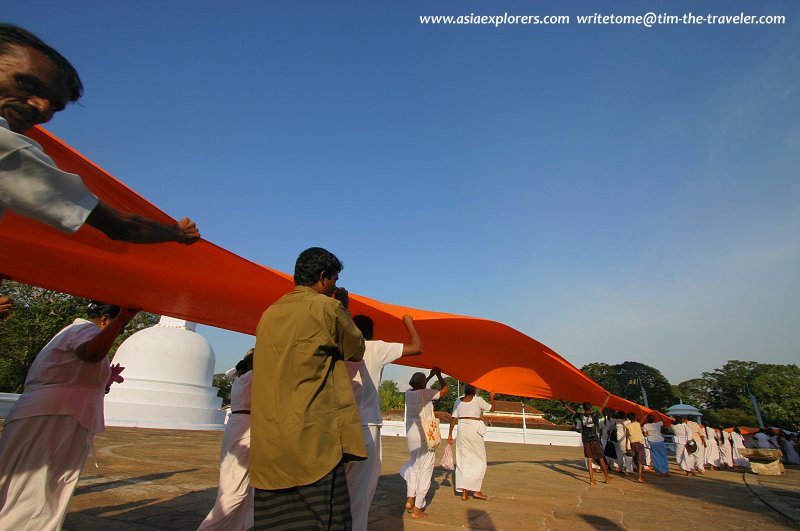
Shwedagon Pagoda, Yangon.
History of the Shwedagon
According to legend, the founding of Shwedagon goes back to the time that Gaudama Buddha achieved Enlightenment, when he discovered the cause of universal suffering and the way to its elimination. The Buddha had appeared before King Okkalapa (in some publications, Ukkalapa) of the Mon people of Lower Burma, promising the king that his wish would be granted. So the king had sent two brothers, Taphussa and Bhallika, to the Buddha. A nat (spirit) who are their mother in a previous existence guided them to the Buddha, and they arrived on the 49th day of Enlightenment.
The brothers offered the Buddha honey cakes called Kywet kyit. After Buddha had eaten the cakes, the brothers asked for gift. The Buddha passed His hand over His head and, obtaining eight stands of hairs which he gave to the brothers. As the three previous Buddhas had caused their possessions to be enshrined in a pagoda on one Singuttara Hill in the brothers' home country, the present Buddha asked them to do likewise with the sacred hairs.
The way home was equally treacherous. Along the journey, the brothers were robbed of two of Buddha's hairs by the King of Ajetta. Then, as they crossed the Bay of Bengal, another two hairs were snatched by the King of the Nagas, who lived on the sed bed. Nevertheless, the brothers eventually arrived home, where they were greated with a big feast by King Okkalapa returned home, arriving at a place called Pagoda Point in the south-west coast of Myanmar. They sent a message to King Ukkalapa, who threw a big ceremony to welcome the sacred hair. All this took place in Asitanzana, north-west of present Yangon.
When the king opened the casket containing the hairs, to his surprise all eight hairs are back in place. As he gazed at it in wonder, the hairs started to emit a brilliant light. Suddenly, the blind people everywhere could see, the deaf could hear, the dumb could speak and the lame could walk. The earth shook and lightning flashed. The king decided that the hairs would be enshrined in Singuttara Hill, just like the previous relics, but he did not know where this hill is located. After consultation with nat spirits, they discovered that Singuttara Hill is also known by other names, one of them Trikhumba, which means three pots, because the hill is shaped like three pots. And so Buddha's Hairs were enshrined and stupa consecrated on the full moon day of Tabaung (March 6, circa 588 B.C.)
How Shwedagon got its name
The name Shwedagon comes from two words: shwe which means gold, and dagon, which is derived from the word Trikhumba, meaning three hills. Dagon became the name of where the Shwedagon stood, and also became the old name of the village where Yangon today stands.
A long time after the shrine was built, it gradually fell into ruin and was covered with jungle. In around 543 BC., two monks from Sri Lanka, Sona and Uttara, brought King Asoka to the Pagoda. The King had the jungle cleared and the Pagoda repaired.
In the fifth century A.D. King Duttabaung paid homage at the Pagoda. In the 11th century, King Anawratha of Bagan offered gold and silver umbrellas and built a pagoda near the town of Twante across the Yangon River.
After the fall of Bagan in the 13th century and the reemergence of Mon power in the 14th with the capital at Bago, Dagon became an important religious centre. At one time, it was reported to contain thirty-two ordination halls.
It was Binnya U (1348-83), the Mon king of Bago who created a pagoda at Shwedagon. The initial height was 18 m. (60'). Successive Mon King of the 15th century raised the height of Pagoda by encasing earlier pagoda and embellishing the new. King Binnyayan (1426-46) cut down the hill and enlarged the base to five terraces to sustain the height. Unfortunately, he died before he could finish the work. His successor, King Binnyawaru (1446-50) who was helped by his mother, Queen Shin Saw Bu, the only regnant queen of Myanmar, raised the height of the Pagoda to 90.6 m(302').
Queen Shin Saw Bu was the first to gild the Pagoda. She went on the scales and let them take her weight which was a bout 40 kg.(90 lbs). Then she donated her own weight in gold, to be beaten and used to plate the stupa. Her successor King Dhammazedi went even further, by donating four times his own weight in gold. He also erected the stone inscriptions standing on Pagoda Hill. The inscriptions tell of the history of the pagoda, in three languages, Burmese, Pali and Mon. The inscriptions can still be seen today. He also donated a huge bell - at 30 tons, it was the biggest in the world. In 1608 the Portuguese mercenary Philip de Brito y Nicote plundered it but it fell into the Bago river and has never been recovered.
The renovations to Shwedagon
In 1572, King Bayinnaung rebuilt the Pagoda to 360 ft and had it regilded. The shrine had been damaged in an earthquake in 1564. Bayinnaung repeated the trip in 1581. After the founding of the Shwedagon Pagoda, Alaungpaya's conquest of Lower Burma is the second most important event in the history of Dagon. May 1775 marks the beginning of the modern town when Alaungpaya, to commemorate his victory, changed its name from Dagon to Yangon, "Enmity Exhausted."
Shwedagon Photo Gallery
Please click the thumbnail on the left to view more photos of Shwedagon.
Exploring the Sights in Yangon
Yangon, previously known as Rangoon, was the capital of Myanmar until a few years ago. It continues to be the commercial hub of Myanmar. Click enter to view the sights there.
About the Author: AsiaExplorers is researched and written by Timothy Tye. We take reasonable care to check and verify the accuracy of the content. However, we disclaim any responsibility for any inconvenience, mishap, injury or death resulting from following the advice provided directly or indirectly by AsiaExplorers and the comments on its pages. All the photographs in AsiaExplorers are available for publication. Please contact AsiaExplorers at the following email address for your enquiries: