Your base for exploring this destination is the city of Singapore. For travel information about Singapore, go to Singapore Travel Guide. If planning a trip to Singapore, view the Singapore Budget Accommodation Map to find a suitable place to spend the night.
Singapore, acclaimed by the Singapore Tourist Board as Uniquely Singapore, is an exciting travel destination at the crossroad of Asia. Located at the southern tip of the Malay Peninsula, Singapore is the smallest country in Southeast Asia. The name Singapore means Lion City. It is a derivation of its Malay name Singapura, which itself is derived from the Sanskrit words simha meaning lion, and pura meaning city. According to folklore, the name came about when the person who first landed on the island, a prince from Sumatra by the name of Sang Nila Utama @ Sri Tri Buana, saw a beast which he took to be a lion, and hence gave the name Singapura to the island. Sang Nila Utama ruled over Singapura for 48 years, and was buried at Bukit Larangan in present-day Fort Canning Hill.
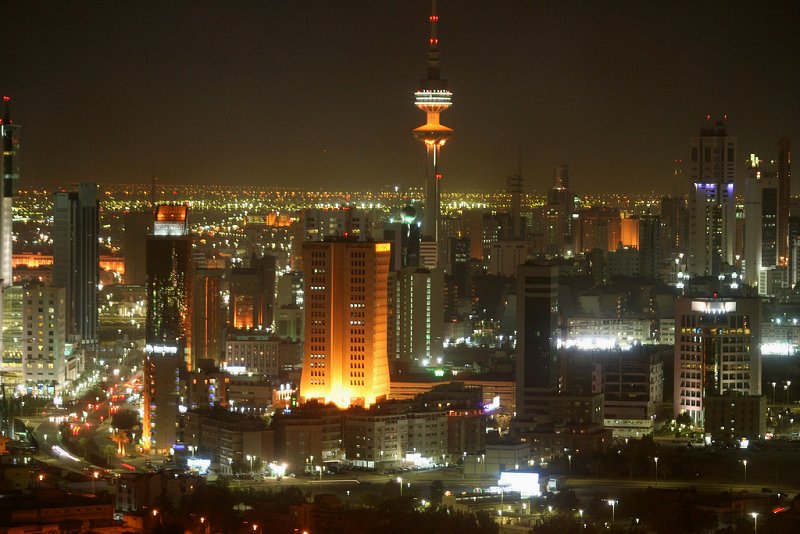
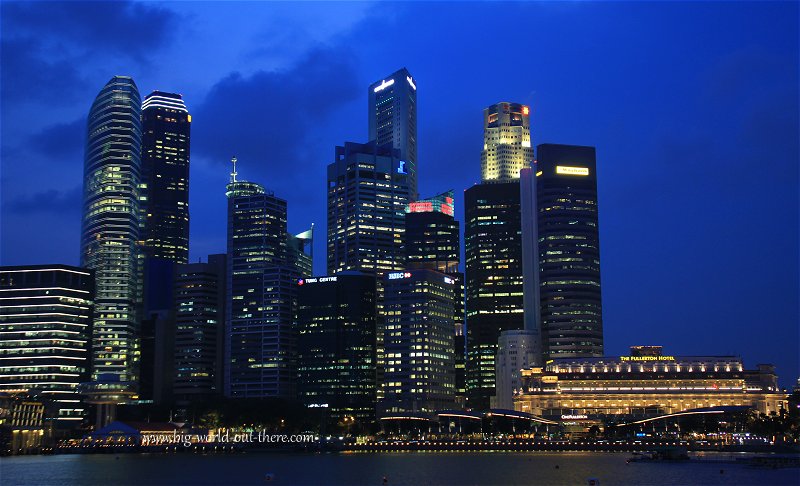
Skyscrapers of the Central Business District, Singapore.
Running parallel to the Sang Nila Utama legend are documented records of the Chinese, going back to as early as the 3rd Century AD, mentioning the island, calling it Pu Luo Chung, a transliteration from the Malay Pulau Ujong, meaning "the island at the end (of the peninsula)". Singapore was part of the Srivijaya empire and was known by the Javanese name Temasek, which means sea town.
History of Singapore
In the 1390's, the Srivijayan prince Parameswara arrive at Temasek after his principality was taken by the Majapahit empire. According to some accounts, he was the fifth king of Temasek, ruling it for a few years before being ejected out of Singapore. On the run again, he landed further up the coast of the Malay peninsula, and founded Malacca. At which point did Paramesware embrace Islam and took on the name of Iskandar Shah is not conclusive. Keramat Iskandar Shah at Fort Canning is regarded as a shrine attributed to him.
Archaeological excavations in the Fort Canning area are uncovering fragmented evidence of pre-Raffles Singapore. From the 16th to the 19th Centuries, Singapore was part of the Sultanate of Johore, and was also set ablaze by the Portuguese in the Malay-Portugal war of 1617.
Stamford Raffles
Sir Thomas Stamford Raffles, an illustrious figure whose imprint on Southeast Asia included the discovery of Borobudur, saving Malacca's Porta de Santiago from total demolition, as well as the introduction of the five-foot way, was the person who founded Singapore. By then, the British has already concluded that Penang was not strategically located, and was looking for a superior trading post. Also, Raffles wanted to influence the British sphere of influence in the region where the Dutch was dominant.
While he was the Lieutenant-Governor of Bencoolen (presently Bengkulu in Sumatra), Raffles convinced Lord Hasting, the Governor-General of India, and his superiors at the British East India Company, to fund an expedition to look for and establish a new British base. In late 1818, Raffles received the tacit approval of Lord Hasting - tacit because the British did not want to openly declare their intentions to the Dutch.
Between 1818 and 1825, Malacca was back in Dutch hands. The British had taken over Malacca by peaceful means on 15 August 1795. In 1818, as compensation to Britain for returning Malacca to the Dutch at the end of the Napoleonic Wars, the Dutch allowed the British to found Singapore, little knowing that it will become a regional powerhouse. Later, in 1824, an agreement in London redefined the British and Dutch spheres of influence, with Britain taking the land north of the Straits of Malacca, while Dutch those south of it.
Raffles landed in Singapore on 29 January 1819 and immediately recognised it as an excellent choice for a new harbour. However, he needed to hatch a plan to get the island. At that time, Singapore was nominally ruled by the Sultan of Johor, Tengku Rahman, who was under the control of the Dutch and the Bugis. As is so often the case, there was a tussle for the throne of Johor, between Tengku Rehman, who was the younger, and Tengku Hussein, the elder. There was a small Malay settlement on Singapore headed by Temenggong Abdur Rahman, who was loyal to Tengku Rahman's elder brother, Tengku Hussein. Tengku Hussein was at that time in exile in Riau.
With the Temenggong's assistance, Raffles smuggled Tengku Hussein to Singapore, where he then recognised Tengku Hussein as the rightful Sultan of Johor. In return of a yearly payment, Tengku Hussein would grant the British rights to establish a trading post in Singapore. With the signing of the treaty on 6 February 1819, the modern history of Singapore began.
After the signing of the treaty, Raffles returned to Bencoolen. He put Major William Farquhar in charged, as British Resident and Commandant of Singapore. At this point, I need to detour from describing Singapore's history, to describe the relationship between Raffles and William Farquhar. There is likelihood, in my opinion, that the two never saw eye-to-eye on more than one occasion. Let me tell you how these met the first time.
In 1803, after Malacca passed from Dutch to the British, Farquhar was the Resident of Malacca. The British Government, not wanting to hand back Malacca with a formidable fortress intact, gave Farquhar the task of demolishing it. (It has to be noted here, however, that the person who recommended the destruction of the Malacca Fort and the city of Malacca, and the transfer of its population to Penang, was not William Farquhar, but Lieutenant-Governor of Penang, Robert Townsend Farquhar, after whom Farquhar Street in Penang was named.)
Abdullah Munshi
According to some accounts, including that of imminent Malay writer, Abdullah bin Abdul Kadir (alias Abdullah Munshi), "Mr Farquhar appeared on horseback holding a slow match in his hand. He sent men to clear out everyone on the Fort side, and they ran away in all directions. Then he touched off the fuse and at once spurred his horse away. After about ten minutes the gunpowder exploded with noise like thunder, and pieces of the Fort as large as elephants and even some as large as houses, were blown into the air and casdaded into the sea." (Abdullah Munshi was just about 14 years old when demolition of the Malacca Fort began; he was later hired by Raffles to be his copyist.)
This frivolous act drew condemnation from many imminent people of that time. Portuguese traveller Carlos José Caldeira called it "an act of vandalism" while British Lord Minto described it as "a useless piece of gratuitous mischief."
The demolition of the Malacca Fort was in its advanced stage when twenty-six year old Raffles arrived in Malacca in 1807, having just been promoted to the position of government secretary in Penang (to read about Raffles's stay in Penang, go to the AsiaExplorers page on Runnymede). Shocked to see that destruction to the Fort, Raffles wrote a persuasive letter urging the government to safe it. This he followed up with direct intervention upon his return to Penang. Due to his effort, Raffles managed to save the gateway to Malacca Fort, which is Porta de Santiago.
That Raffles and William Farquhar were not in agreement over the fate of the Malacca Fort makes it all the most peculiar that eleven years later, it was Raffles who put Farquhar in charge of running Singapore upon signing the treaty. In effect, Farquhar was left to his own devices for four years.
It must have been tough for Farquhar to run Singapore without steady revenue. Raffles had forbidden him from collecting port duties. To generate some cash, Farquhar started selling licenses for gambling and the sale of opium, the opening of brothels and the selling of slaves. When Raffles returned in 1823, he was shocked at how Farquhar was running Singapore. Immediately he dismissed Farquhar, who initially refused to leave. (Farquhar had a Malay wife, he speaks the local language, and is well-liked by the locals.) Farquhar even attempted to sue Raffles for tyrannical behaviour. Nevertheless in the end, Farquhar settled for a comfortable retirement in Scotland, where he had bought two large mansions.
With Farquhar out of the picture, Raffles drafted a new set of policies for Singapore. It was known as the Raffles Plan of Singapore, also known as the Plan of the Town of Singapore, and as the Jackson Plan of 1822, after Lieutenant Philip Jackson, the engineer who oversaw Singapore's physical development.
According to the Plan, residential areas were parcelled out according to ethnic groups. European Town had residents consisting of European traders, Eurasians and rich Asians, and is in the area today bounded by Waterloo Street, Middle Road, Beach Road and Stamford Road. Chinese Kampong is for the ethnic Chinese, and is located in present-day Chinatown. Chulia Kampong is the parcel for the ethnic Indians and was further north of the Chinese Kampong, along Chulia Street (though not at present-day Little India). Kampong Glam, still called the same name today, is for the ethnic Malays and Arabs, and is further divided to three parts, for the Bugis, the Arabs, and the Sultan of Singapore, as expressed in the names of the roads in Kampong Glam today.
In this AsiaExplorers travel documentation of Singapore, I want to take you to the places that were the result of the Raffles Plan, places in the Civic District, where the history of Singapore began, to the different ethnic communities that were carved out according to Raffles vision for this island. I hope you will enjoy many places described, whether you have the opportunity of doing it in person, or rely entirely on the AsiaExplorers website, to explore from the comfort of your desktop.
Thank you, thank you, thank you, for the opportunity to explore the world, to document, to photograph, and to share the information with you. My name is Tim, I'm the writer of this website, and I want to tell you how grateful I am for your visit. This is one of over a dozen websites that I write - you can click my thumbnail photo above to randomly visit any one of them. All my photos are available for commercial printing - find out the photo usage rights here. If you wish to share you photos on this website, upload them to www.panoramio.com and send the URL to me for consideration. And, if you'd like to correspond with me, send your mails to my address as shown below:
About the Author: AsiaExplorers is researched and written by Timothy Tye. We take reasonable care to check and verify the accuracy of the content. However, we disclaim any responsibility for any inconvenience, mishap, injury or death resulting from following the advice provided directly or indirectly by AsiaExplorers and the comments on its pages. All the photographs in AsiaExplorers are available for publication. Please contact AsiaExplorers at the following email address for your enquiries: