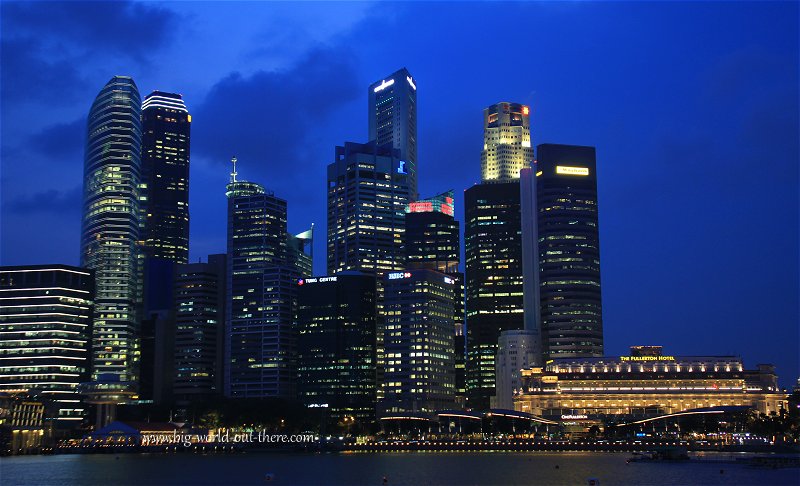
Your base for exploring this destination is the city of Singapore. For travel information about Singapore, go to Singapore Travel Guide. If planning a trip to Singapore, view the Singapore Budget Accommodation Map to find a suitable place to spend the night.
Kayakers negotiating a bend of the Singapore River near UOB Plaza.
Singapore River is the most important as well as the most historic river in Singapore. It flows right through the downtown core of the city of Singapore before emptying into Marina Bay, an area which was formerly sea, but has now seen land reclamation surrounding it, reducing it into a bay.
The history of Singapore is closely linked to the Singapore River. It was here that the first port developed. The city itself grew around the port. A site on the north bank of the river is regarded as where Sir Stamford Raffles first set foot on Singapore. Later on (after some initial haphazard planning by William Farquhar), Raffles himself oversaw the planning of the city of Singapore, parcelling our specific sections for Europeans and Jews, Chinese, Indians and the Malays and Arabs.
The Europeans occupied the area north of the Singapore River. Also located here is what is today regarded as the Civic District, where most of Singapore's colonial government offices were located. However, it was the area south of the Singapore River, the area where bumboats congregated and jostled for berthing space, that saw the most activity. This section, known today as Boat Quay, is indeed the very lifeblood of the new British port and colony.
The Chinese considered this section of the Singapore River particularly auspicious, as is resembles the full belly of the carp. So the area is lined with Chinese merchant houses and godowns. And where land meets river, there are wharfs and wooden piers. You can almost imagine Chinamen coolies carrying on their backs heavy sacks of rice, onions, spices. The Singapore river itself was choked full of sampans, prahus, tongkongs, boats of every shape and design. The bigger ships anchored out at sea and are unloaded onto smaller lighters or bumboats which ferry their cargo to the Boat Quay and Clarke Quay.
The place was polluted, dirty, smelly - but did it matter? However, as the Singapore society became more urbanized, so the perception of the Singapore River changed with it. Eventually it was no longer acceptable to have a dirty river flowing right through the city.
Old Chinese merchant houses along the quay at Singapore River are now converted into restaurants.
Former prime minister Lee Kuan Yew set the ball rolling when he declared in 1977 that he wanted fishing to be possible again on the Singapore River and Kallang Basin within ten years. With that said, the "Clean-up of the Singapore River and Kallang Basin" plan was put into action. It involved overall improvement of the infrastructure, resettlement of squatters, re-siting of hawker centres, and the phasing out of pollutive activites. In addition, the river bed had to be dredged to make it suitable for marine life to thrive there once more.
In September 1987, ten years after the campaign started, the Ministry of Environment celebrated the success of the clean-up with an event called the "Clean River Commemoration". Today only non-polluting vessels are allowed on the Singapore River.
Plans are afoot to dam the Singapore river. By doing that, Singapore River becomes a new source of fresh water supply for the resource hungry nation. In addition, damming will prevent pollution from the sea from entering the river and makes it easier to control the quality of the water.
About the Author: AsiaExplorers is researched and written by Timothy Tye. We take reasonable care to check and verify the accuracy of the content. However, we disclaim any responsibility for any inconvenience, mishap, injury or death resulting from following the advice provided directly or indirectly by AsiaExplorers and the comments on its pages. All the photographs in AsiaExplorers are available for publication. Please contact AsiaExplorers at the following email address for your enquiries: