Home Sri Lanka (ශ්‍රී ලංකාව) Travel Guide


Exotic Tours of Asia
 Asia Travel Guide Find Hotels       
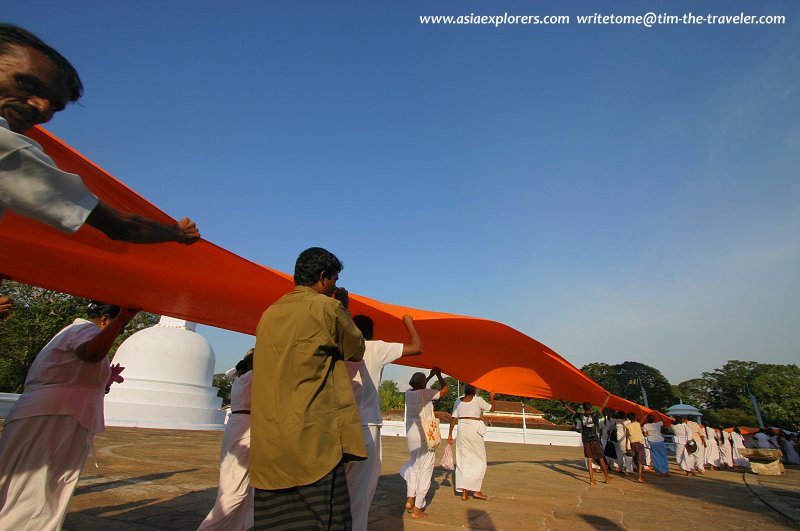
Pilgrims at Ruwanweliseya Dagoba, Anuradhapura
© Timothy Tye (28 August 2005)


Sri Lanka (Sinhala: ශ්‍රී ලංකාව; Tamil: இலங்கை) is a country located almost at the southernmost tip of the Indian subcontinent. Dangling like an emerald pendant, it is a dazzlingly beautiful country blessed with an ancient history that stretches for over two thousand years. This endows Sri Lanka with a multitude of ancient ruins, many of which today receive recognition from Unesco as World Heritage Sites.

Guide to Sri Lanka Hotels

It's never easy finding the hotel that's just right for your stay. Still, by taking a little time to do your research, you increase your chance of getting a good hotel at the best price. Go through the list of hotels in Sri Lanka which we've put together, arranged city by city, with full description, star rating, address, location map and evaluation. Pick the hotel of your choice and view the rates offered by different booking sites. Yes, we show you prices from different websites, so you don't have to visit them one by one.


Climbing Sigiriya
Climbing Sigiriya
© Timothy Tye (29 August 2005)

More about Sri Lanka

I have had the opportunity to explore Sri Lanka with a small group of AsiaExplorers members, and I want to take you now to some of the beautiful places that we visited. We will visit the ancient ruins in the northern plains, cities like Anuradhapura, Polonnaruwa, Sigiriya, Dambulla and Kandy, each recognised today as a Unesco World Heritage Site.

As I explored the ancient Sri Lankan cities, I cannot help being amazed at the engineering feats of the Sri Lankan people a thousand years ago. From the low, arid country, we proceed to the highlands, to the tea country. At Nuwara Eliya, we enjoyed the lovely scenery and cool climate. We also had the good fortune of staying at the Tea Factory, a 5-star hotel that was once a tea processing plant, and which won a Unesco award for heritage conservation.

From the highlands, we proceeded southwards, to the southernmost major city of Sri Lanka, Galle, where we visited another Unesco World Heritage Site, Galle Fort. Along the way, we stopped over to look at the devastation caused by the tsunami of December 2004.

In any write-ups about Sri Lanka, it would be glaring not to mention the internal conflict that plagues the nation. It is an issue that concerns most people as they contemplate a trip there - is it worth the risk? From my experience with Sri Lanka, although the internal conflict between the primarily Sinhalese government and the Liberation Tigers of Tamil Eelam often dents Sri Lanka's image as a tourist destination, in actual fact, most of the tourist destinations are free from attacks. And quite safe too.


Pinnawela Elephant Orphanage
© Timothy Tye (28 August 2005)

Having said that, I have to caution you to be prepared for tight security in Sri Lanka, especially in Colombo. In the downtown area of Fort, for example, I was forbidden from taking photographs. I saw soldiers all over the Fort district. This is due to the military installation nearby. Therefore, one of Colombo's most prominent landmarks, the lighthouse Clock Tower, is out of bounds for photography. Also, I learned that many of the major hotels have been bombed before, including the one where we were staying during out Sri Lankan trip, the 5-star Galadari Hotel.

Fortunately, the rest of Sri Lanka, outside of the troubled north, is still very safe and open. Not only that, the people are generally friendly and gracious, and makes every visitor feel welcome. On this website, I want to show you most of the major tourist sites, including the ancient cities, highland getaways, Sri Lankan culture and forts.

Sri Lanka Travel Information

  • Official Name: Democratic Socialist Republic of Sri Lanka
  • Capital: Colombo (710,000, metropolitan area: 2,500,000)
  • Population of the Sri Lanka: 20,064,800; 74% Sinhalese, 18& Tamil, 7% Muslim of Arab and Indian Muslim descent
  • Religions: Buddhist (70%), Islam (26%), Hindu, others
  • Languages: Sinhala, Tamil, others
  • Currency: Sri Lankan Rupee
  • Time Zone: 6 hours ahead of Greenwich Mean Time.
  • International Dialing Code: 94
  • Electricity: 230-240V 50Hz; Most outlets use the three-pronged sockets. If travelling with a laptop, bring along a stabiliser in addition to adaptor, as power often fluctuates. (See details here: http://www.kropla.com/electric.htm)
  • Driving: On the left side of the road.

  • Size: 65,610 sq km (25,332 sq miles)
  • Region: Asia
    How to find accommodation: Sri Lanka Hotels

    It is wise to do a bit of homework before you book your hotel room in Sri Lanka. You will be surprised to discover that different hotel booking websites actually offer the same room at vastly different prices. Use our free Sri Lanka Hotel Search Engine to view and compare the prices offered for hotel rooms by different booking sites. It helps you make an informed decision that can potentially save you a lot of money.

    If you are backpacking to Sri Lanka, you can view hostels in Sri Lanka online booking.


    Panoramic view of Mihintale
    Panoramic view of Mihintale
    © Timothy Tye (30 August 2005)

    How to enter Sri Lanka

    The Colombo Bandaranaike International Airport (CMB) located north of Colombo is the main gateway into Sri Lanka. It is the base for national flag carrier Sri Lankan Airlines. Upon arriving at the airport, you can catch a taxi or a three-wheeler to the city.

    Sri Lanka Public Holidays

    Sri Lanka observed plenty of public holidays. The three with a fixed date are:
  • National Day: 4 February
  • May Day: 1 May
  • Christmas Day: 25 December

    The following Muslim festive days are public holidays. They occur at different times of the year according to the Muslim calendar:
  • Id-Ul-Fitr: Ramazan Festival Day
  • Id-Ul-Allh: Hajji Festival Day
  • Milad-Un-Nabi: Birthday of the Propher Muhammad

    The following Buddhist and Tamil festive days are public holidays that vary from year to year, but observe specific seasonal period. Poya, or Full Moon Day, is a public holiday as well.
  • Tamil Thai Pongal: January
  • Durutu Poya: January
  • Navan Poya: February
  • Mahasivarathri: March
  • Medin Poya: March
  • Good Friday: March/April
  • Eve of the Sinhala/Tamil New Year: April
  • Sinhala/Tamil New Year: April
  • Bak Poya: April
  • Vesak Poya: May
  • Day after Vesak Poya: May
  • Poson Poya: June
  • Esala Poya: July
  • Nikini Poya: August
  • Binara Poya: September
  • Vap Poya: October
  • Deepavali Poya: October/November
  • Il Poya: November
  • Unduvap Poya: December

    History of Sri Lanka

    Sri Lanka has a long history that goes back to the dawn of time. The history of the Sinhala people began with the arrival of an Indian prince named Vijaya. On the island of Lanka (the ancient name for Sri Lanka), Vijaya discovered that it was already inhabited, by a people called Yaksha. He took as his wife the queen of the Yakshas. Later, Vijaya took another wife, a Pandyan princess from South India, and he also brought women from there to be wives of his followers. They were regarded as the earliest settlers of Lanka.

    Buddhism was introduced to Lanka in the 3rd century BC. It came about when a Buddhist missionary, Bhikkhu Mahinda, who is the brother of the Buddhist Emperor Asoka of India, arrived in Lanka, and succeeded in converting the Sinhalese King Devanampiyatissa at Mihintale.

    The first ancient capital of Lanka was the city of Anuradhapura. Next came Polonnaruwa. There were a succession of other cities that served as capital. Throughout history, there was repeated invasions by armies from South India, resulting in the shifting of the capital.

    Colonial powers arrived in Sri Lanka in 1505, when the Portuguese landed. At that time there were three kingdoms on the island, namely Yarlpanam (Anglicised Jaffna) in the north, Kandy in the central hills and Kotte at the Western coast. In 1956, the Dutch defeated the Portuguese and became the second colonial power in Sri Lanka. As the Portuguese and Dutch were mainly interested in the spice trade, and so concentrated only on the coastal areas. The hilly region remained independent, allowing the Kingdom of Kandy to continue flourishing uninterrupted, until the arrival of the British.

    Great Britain replaced the Dutch in 1796 - at a time when the Netherlands were weakened by the Napoleon invasion back home. The coastal areas became a crown colony in 1802. The kingdom of Kandy fell in 1815, setting in motion the unification of the entire island under a single administration, which happened in 1818.

    A struggle for independence started in the 1930s, and Sri Lanka won its independence in 1948, becoming a member of the British Commonwealth. Under British rule, it was known as Ceylon, a name that it held until 1972, when it changed its name to Sri Lanka. The name Sri Lanka, which has its origin in Sanskrit, means "venerable Lanka". Lanka is a name that has long been associated with the island since ancient times.

    Useful Links

  • Galle Vacation Rentals: Browse thousands of rentals on TripAdvisor.


  • Major Attractions of Sri Lanka

    1. Colombo - Capital of Sri Lanka
    2. Anuradhapura - Most famous ancient city.
    3. Aukana Buddha - Mammoth standing Buddha statue.
    4. Dambulla Cave Temple - Site of amazing cave temples.
    5. Kandy - Last major kingdom of Sri Lanka.
    6. Mihintale - Sacred site where Buddhism was first introduced into Sri Lanka.
    7. Nuwara Eliya - Major tea plantation highlands.
    8. Polonnaruwa - Second ancient capital of Sri Lanka.
    9. Sigiriya - Site of ancient palace complex.

    Cities and Sights on the West Coast of Sri Lanka

    1. Akurela Beach
    2. Aluthgama
    3. Ambagahapityia Welitara
    4. Ambalangoda
    5. Balapitiya
    6. Bentota
    7. Beruwala
    8. Brief
    9. Chilaw
    10. Dodunduwa
    11. Galagoda Temple
    12. Galapata Vihara
    13. Gangatilaka Vihara
    14. Hikkaduwa
    15. Induruwa
    16. Kachimalai Mosque
    17. Kalutara
    18. Kosgoda
    19. Madampe
    20. Mahawewa
    21. Marawila
    22. Moratuwa
    23. Munnesvaram
    24. Narigama
    25. Negombo
    26. Panadura
    27. Panduvasnuwara
    28. Puttalam
    29. Richmond Castle
    30. Sinharaja Rainforest
    31. Sri Janandarama Mahavihara
    32. Sri Pushparama Vihara
    33. Sunandaramaya Mahavihara
    34. Udappuwa
    35. Wewela
    36. Wilpattu National Park
    37. Cities and Sights of the South Coast of Sri Lanka

    38. Bundala Bird Sanctuary
    39. Count de Maunay's Island
    40. Dikwella
    41. Dondra
    42. Galle
    43. Galle Cultural Museum
    44. Galle Fort
    45. Groote Kerk
    46. Hambantota
    47. Hoo-aaniya Blowhole
    48. Kataluwa Temple
    49. Kataragama
    50. Koggala
    51. Koggala Lake
    52. Kottuwa Rainforest
    53. Maha Vishnu Devala
    54. Martin Wickramasinghe Folk Art Museum
    55. Matara
    56. Matara Fort
    57. Mulgirigalla
    58. Museum of Ancient Paintings
    59. National Maritime Museum
    60. Polhena
    61. Tangalla Bay
    62. Tissamaharama
    63. Uda Walawe National Park
    64. Unawatuna Bay
    65. Weligama
    66. Wewurukannala Vihara
    67. Yala National Park
    68. Cities and Sights of the Cultural Heart of Sri Lanka

    69. Aluvihara
    70. Buduruvalagala
    71. Dambadeniya
    72. Dimbulaga
    73. Gadaladeniya
    74. Habarana
    75. Kurunegala
    76. Lankatilaku
    77. Mahiyangana
    78. Medirigiriya
    79. Nalanda Gedige
    80. Panduvasnuwara
    81. Ridigama
    82. Sasseruwa
    83. Somawathie Dagoba
    84. Yapahuwa
    85. Cities and Sights on the East Coast of Sri Lanka

    86. Arugam Bay
    87. Batticaloa
    88. Bundala
    89. Fort Frederick
    90. Kalkudah Bay
    91. Kanniyai
    92. Koddiyar Bay
    93. Kokkilai
    94. Mutur
    95. Nilaveli
    96. Passekudah Bay
    97. Pigeon Island
    98. Seruwawila
    99. Swami Rock
    100. Toppur
    101. Trincomalee
    102. Uppuveli


    Return to Asia Travel Guide
    Return to Discover This World


  • Tips to become a smart traveler: Useful tips to remember, to get the best out of your travels.
  • Preparing for a Trip: Systematic approach to help you prepare for your trip.
  • How to plan your travel itinerary: Step-by-step guide to creating the itinerary for your trip.
  • Find and compare hotel room rates: View room rates from all the different booking sites.
  • Learn to compare room rates: Step-by-step guide on finding the lowest rates every time.
  • When NOT to go where: List of seasons to avoid when traveling the globe.
  • How to pack your luggage: Useful steps to take when packing your luggage.
  • Packing List (PDF): Print out this free packing list to make sure you don't forget anything for your trip.
  • Voltage, Frequency, Plugs & Sockets of the World: Learn about the mains electricity supply in the world.
  • Travelers' List of Plugs and Sockets (PDF): Easy-to-use list of electricity and plugs for all countries.
  • Making International Direct Dail Calls: Learn to make IDD calls from anywhere in the world.
  • IDD Call Prefixes & Country Codes (PDF): Listing of Call Prefixes and Country Codes on one page for you to bring on your trip.
  • Safety Tips When Traveling Alone: Useful advice for when you travel on your own.
  • Guide to Health Matters related to Travel: Comprehensive coverage of different issues related to your health when traveling.
  • Getting Travel Insurance for your trip: Benefits of travel insurance, and advise on when you should signing up for one.
  • Improve your travel photography: Tips to improve your photography skills, especially when traveling.
  • Guide to Traveling Around the World: Useful tips for encircling the globe.
  • English Made Simple: Improve your English for your travel.


  • Follow Me on Pinterest

    Point - Click - Discover!

    Thanks for visiting this webpage. To continue exploring, choose another destination!


    My World Travel Guides - celebrating a beautiful world beautifully.


    SBI! Results