Abhayagiri Vihara
Anuradhapura, Sri Lanka Ancient Heritage City


Your base for exploring this tourist attraction is the ancient city of Anuradhapura, Sri Lanka. For tourist information about Anuradhapura, go to Anuradhapura Travel Guide. To prepare for a trip to Sri Lanka, read also the Sri Lanka Travel Guide. Looking for budget accommodation? Use AsiaExplorers Budget Accommodation Guide, the no-frills website to cover your budget accommodation needs.


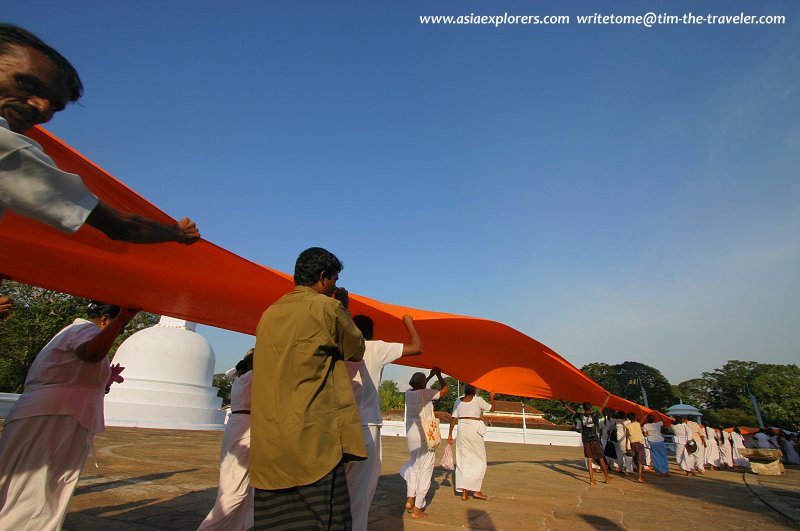
Abhayagiri Vihara is the ruins of a monastery on the northern part of the ancient city of Anuradhapura in Sri Lanka. Abhayagiri was formerly known as Uttaravihara, or Northern Monastery, during the ancient times. Abhayagiri almost became a city of its own rivalling Anuradhapura. For about 600 years, Abhayagiri was the largest monastery in Sri Lanka, housing 5000 monks on its grounds which covered over 500 acres (235 hectares). The focal point of the Abhayagiri Monastery is the Abhayagiri Dagoba and the Ratna Prasada, or chapter house of the Dhammaruci Order.

The Abhayagiri Dagoba is the second biggest brick structure in the world after the Jetavana Dagoba. The Abhayagiri Dagoba was built by King Gajabahu (114-136AD) and reaches a height of 370 feet (115m). Abhayagiri monastery is one of the eight sacred sites for Buddhists in Anuradhapura, Sri Lanka.

It is believed that the Abhayagiri Dagoba was built over the footprint of the Buddha. The Buddha came to Lanka and by his supernatural powers placed one foot in the north of Anuradhapura, the other on top of Adam's Peak.


The Abhayagiri monastery complex in northern Anuradhapura.


Within the Abhayagiri complex is the Samadhi Buddha, which depicts the Buddha in the serene state of samadhi, or deep meditation. A little further north are the twin ponds or Kuttam Pokuna. Beyond the Samadhi Buddha is one of the most outstanding moonstone in Anuradhapura. This moonstone located at the threshold of the queen's pavilion of King Mahasen's Palace.

Moonstones are stone doormats of Sri Lanka temples. They always reflect cosmic symbolism. The outside ring depicts a flame, symbolising desire. The next right is a frieze of animals symbolising vitality. They walk from left to right, the direction of good omen. The Anuradhapura moonstones include bull, horse, elephant and lion, whereas those found in Polonnaruwa, which is later than Anuradhapura, omits the bull out of respect for Hindus.

After the animals are twisting creepers. They represent the life force. According to Buddhism, once you are able to overcome craving, you can choose good over evil. The next stage, symbolising the search for the truth, is represented by the goose, or Hamsa. Next is a scroll of ornamental lotus flowers, the symbol of purity, and finally in the middle, is plainness, symbolising Nirvana, or enlightenment.

Places of interest in Anuradhapura

Anuradhapura Travel Guide

Explore the places of interest in Anuradhapura. Click to view list.

Anuradhapura Travel Guide


Expedia.com


Copyright © 2003-2008 AsiaExplorers.  All rights reserved.

About the Author: AsiaExplorers is researched and written by Timothy Tye. We take reasonable care to check and verify the accuracy of the content. However, we disclaim any responsibility for any inconvenience, mishap, injury or death resulting from following the advice provided directly or indirectly by AsiaExplorers and the comments on its pages. All the photographs in AsiaExplorers are available for publication. Please contact AsiaExplorers at the following email address for your enquiries: