Exploring Anuradhapura First ancient capital of Sri Lanka and Unesco World Heritage Site
Anuradhapura is the first historical capital of Sri Lanka. Today recognised by Unesco as a World Heritage Site, Anuradhapura was established in the 5th century BC. It is located 203 km northeast of Colombo, in the arid northern plains. Anuradhapura was considered the greatest monastic city of the ancient world. At its peak, it had dozens of monasteries housing thousands of monks. I had the privilege of exploring this ancient city with members of AsiaExplorers on an AsiaExplorers Scenic Tour.
Anuradhapura was a royal capital from which a succession of 113 kings reigned here. It was made the capital by King Pandukabhaya who reigned from about 437 BC to 367 BC. Their patronage saw the blossoming of the arts, producing magnificent palaces, sculptures, ornate pleasure gardens, and huge dagobas, the Sri Lankan bubble-shaped stupas that protected the most sacred relics of Buddhism.
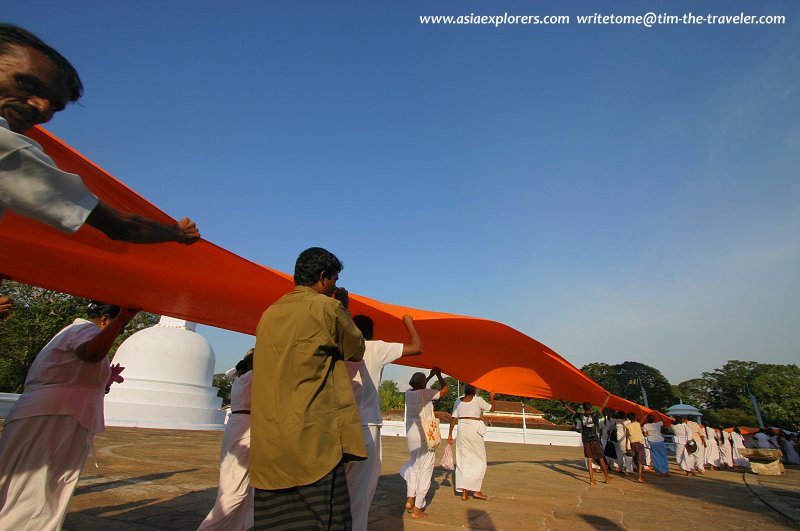
 Devotees encircling the Ruwanweliseya Dagoba in Anuradhapura.
The people of ancient Anuradhapura enjoyed freedom of worship. The kings of ancient Lanka in Anuradhapura built hospitals for people as well as veterinary hospitals for animals. But the most impressive civil engineering feat in Anuradhapura was for irrigation. These are the man-made reservoirs built to preserve the waters of the monsoon rain. They put in place a sluice system to ensure the rice fields receive enough water and are productive.
Ancient Anuradhapura traded with faraway civilisations. The discovery of Roman coins showed that Lanka was active in trading - and was probably an early tourist destination as well, visited by among others, Megasthenes, the Greek ambassador to India, and in the early 5th century, Fa Hien, the Chinese Buddhist pilgrim.
Anuradhapura derived its name from Anuradha, the name of one of the chief minister during King Vijaya's time, who founded the city around 500BC during the reign of King Pandukabhaya. By 161BC, the whole island was the control of King Dutugemunu with Anuradhapura as the capital. Anuradhapura was only abandoned in 1073 when Polonnaruwa became the new capital.
|
 |
Jetavana Dagoba
The tallest brick structure in the world.
|
|
 |
Abhayagiri Vihara
The ruins of an ancient monastery which once housed over 5000 monks.
|
|
 |
Kuttam Pokuna
Bathing pool of the monks of Abhayagiri Monastery.
|
|
 |
Abhayagiri Giant Pond
The largest pond in Anuradhapura.
|
|
 |
Lankarama Dagoba
A restored ancient shrine near the Thuparama Dagoba.
|
|
 |
Thuparama Dagoba
The stupa that enshrines Buddha's collar-bone relic.
|
|
 |
Ruwanweliseya Dagoba
The most important stupa and also second tallest in Anuradhapura.
|
|
 |
Dakkhina Stupa
2nd century BC stupa built over the cremated ashes of King Dutugemunu.
|
|
 |
Sri Maha Bodhi Temple
The temple of the oldest planted tree in the world.
|
|
|