Polonnaruwa Travel Guide
Second Ancient Capital of Sri Lanka and Unesco World Heritage Site


Your base for exploring this tourist attraction is the ancient city of Polonnaruwa, Sri Lanka. For tourist information about Polonnaruwa, go to Polonnaruwa Travel Guide. To prepare for a trip to Sri Lanka, read also the Sri Lanka Travel Guide. Looking for budget accommodation there? Use AsiaExplorers Budget Accommodation Guide, the no-frills website to cover your budget accommodation needs.


The medieval city of Polonnaruwa was the capital of the second civilisation to establish itself in ancient Lanka after Anuradhapura. It was the seat of the Sinhala Kingdom between the middle of the 11th century to the 13th century.

Grew out of the arid plains of the north, the kingdom in Polonnaruwa depended heavily on channelled water to irrigate its fields. This demanded the construction of massive irrigation projects. Although the civilisation in Sri Lanka is not as popular, their engineering feat rival those of Angkor, Egypt and ancient China.


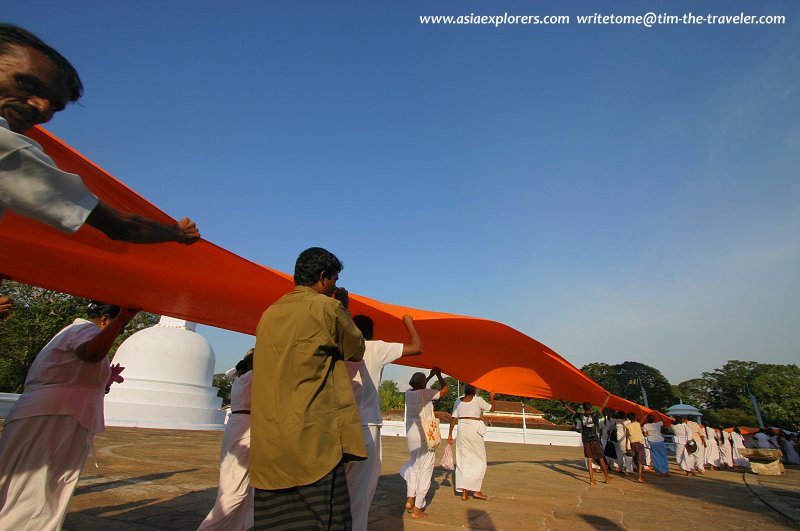
Rankot Vihara Dagoba in Polonnaruwa.


The greatest king in Polonnaruwa is Parakramabahu I, a warrior and great builder. It was he who build the massive Parakrama Samudra. It is worth Polonnaruwa to appreciate the engineering marvels of a civilisation that flourished a millenium ago, that today makes Polonnaruwa worthy of recognition as a Unesco World Heritage Site.


Parakrama Samudra

Great irrigation pond of King Parakramabahu.

King Parakramabahu's Palace

Ruins of King Parakramabahu's 12th century palace.

King Parakramabahu's Council Chamber

Audience hall of King Parakramabahu with elaborately sculptured walls.

Shiva Devale

Ruins of a Hindu temple built by South Indian invaders.

Thuparama Image House

The best preserved ancient building in Polonnaruwa.

Vatadage Circular Relic House

Built in the 7th century, the Vatadage is the oldest monument in Polonnaruwa.

Lata Mandapa

Pavillion of King Nissanka Malla.

Atadage

The first Tooth Relic Shrine of Polonnaruwa, built in the 11th century by King Vijayabahu.

Hatadage

The second Tooth Relic Shrine of Polonnaruwa, built in the 12th century by King Nissanka Malla.

Gal Pota

The Stone Book of King Nissanka Malla.

Satmahal Prasada

An unusual stupa in the form of a seven-tiered step pyramid.

Rankot Vihara

Nissanka Malla's golden pinnacle dagoba.

Gal Vihara

The famous rock sculptures of Polonnaruwa.


Sri Lanka Travel Guide

Sri Lanka Travel Guide

Useful tips for preparing your trip to Sri Lanka.

Sri Lanka Travel Guide


Thank you, thank you, thank you, for the opportunity to explore the world, to document, to photograph, and to share the information with you. My name is Tim, I'm the writer of this website, and I want to tell you how grateful I am for your visit. This is one of over a dozen websites that I write - you can click my thumbnail photo above to randomly visit any one of them. All my photos are available for commercial printing - find out the photo usage rights here. If you wish to share you photos on this website, upload them to www.panoramio.com and send the URL to me for consideration. And, if you'd like to correspond with me, send your mails to my address as shown below:


Here's the latest updates from my websites ...


Expedia.com


Copyright © 2003-2008 AsiaExplorers.  All rights reserved.

About the Author: AsiaExplorers is researched and written by Timothy Tye. We take reasonable care to check and verify the accuracy of the content. However, we disclaim any responsibility for any inconvenience, mishap, injury or death resulting from following the advice provided directly or indirectly by AsiaExplorers and the comments on its pages. All the photographs in AsiaExplorers are available for publication. Please contact AsiaExplorers at the following email address for your enquiries: