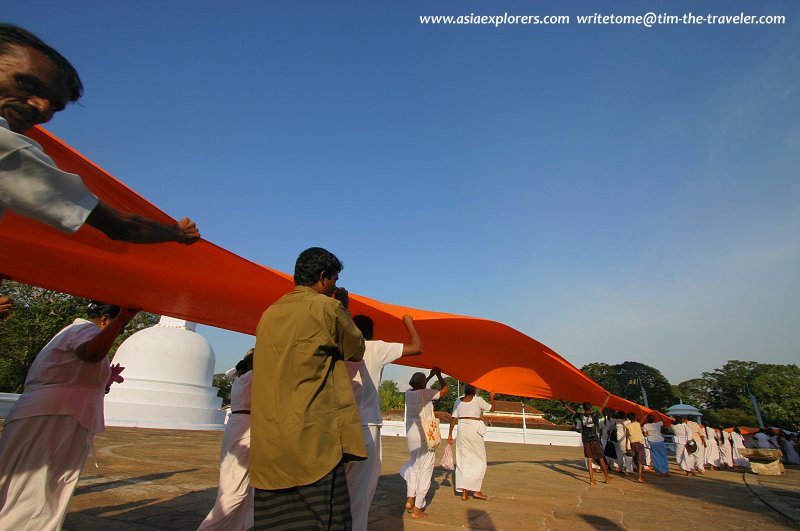
 Polonnaruwa Travel Guide, Sri Lanka
 The Reclining Buddha at Gal Vihara, Polonnaruwa Author: Lankapic (Creative Commons Attribution 3.0 Unported)
The ancient city of Polonnaruwa is one of the UNESCO World Heritage Sites in Sri Lanka.
The medieval city of Polonnaruwa was the capital of the second civilisation to establish itself in ancient Lanka after Anuradhapura. It was the seat of the Sinhala Kingdom between the middle of the 11th century to the 13th century.
 Kiri Vihara, Polonnaruwa Author: Bernard Gagnon (Creative Commons Attribution 3.0 Unported)
World Heritage Site Inscription Details
Location: N7 54 57 E81 00 02
Inscription Year: 1982
Type of Site: Cultural / Natural / Mixed
Inscription Criteria: I, III, VI
Grew out of the arid plains of the north, the kingdom in Polonnaruwa depended heavily on channelled water to irrigate its fields. This demanded the construction of massive irrigation projects. Although the civilisation in Sri Lanka is not as popular, their engineering feat rival those of Angkor, Egypt and ancient China.
 Kumura Pukuna basin, Polonnaruwa Author: Bernard Gagnon (Creative Commons Attribution 3.0 Unported)
The greatest king in Polonnaruwa is Parakramabahu I, a warrior and great builder. It was he who build the massive Parakrama Samudra. It is worth Polonnaruwa to appreciate the engineering marvels of a civilisation that flourished a millenium ago, that today makes Polonnaruwa worthy of recognition as a Unesco World Heritage Site.
Visiting Polonnaruwa
If you are traveling in a small group, I would recommend hiring a taxi or car with driver to take you to Polonnaruwa, and then explore it with your own transport. Alternatively you can take the bus or the train from Colombo. Polonnaruwa is about 220 km from Colombo, and the road is a bumpy highway, so the journey will take you almost the whole day.
 Lankatilaka Temple, Polonnaruwa Author: Bernard Gagnon (Creative Commons Attribution 3.0 Unported)
|
Tourist Attractions in and around Polonnaruwa |
 |
The first Tooth Relic Shrine of Polonnaruwa, built in the 11th century by King Vijayabahu.
|
|
 |
The Stone Book of King Nissanka Malla.
|
|
 |
The second Tooth Relic Shrine of Polonnaruwa, built in the 12th century by King Nissanka Malla.
|
|
 |
Audience hall of King Parakramabahu with elaborately sculptured walls.
|
|
 |
Ruins of King Parakramabahu's 12th century palace.
|
|
 |
Great irrigation pond of King Parakramabahu.
|
|
 |
Ruins of a Hindu temple built by South Indian invaders.
|
|
 |
The best preserved ancient building in Polonnaruwa.
|
|
 |
Built in the 7th century, the Vatadage is the oldest monument in Polonnaruwa.
|
|
 |
Pavillion of King Nissanka Malla.
|
|
 |
An unusual stupa in the form of a seven-tiered step pyramid.
|
|
 |
Nissanka Malla's golden pinnacle dagoba.
|
|
 |
The famous rock sculptures of Polonnaruwa.
|
|
|