Exploring Hanoi
Hanoi, the capital of Vietnam, is a wonderful travel destination. If you have only seen it in photographs, it is very much what it appears, and more. Yes, it is a boisterous, energetic city dense with bicycles and an increasing number of motorcycles, together creating quite a cacophony on all its major roads. But there is so much to Hanoi than its busy streets. On this travel guide, I want to take you to some of the most beautiful and special places in Hanoi, to serene heritage sites where the din of traffic is momentarily kept at bay.
Hanoi is only second in size to Ho Chi Minh City. Today it has an estimated population of about 3.3 million, while the municipality of Hanoi having a total population of 6.4 million. Much of it is located on the western (left) bank of the Red River.
How to get there
Most foreign visitors arrive by flight at the Noi Bai International Airport, 35 km to the north of Hanoi. From the airport, you can catch a taxi to the city. The cost is between US$14-US$18. It is cheaper to pay in dong.
You can also take the public bus. This costs 5000 dong. Additionally Vietnam Airlines runs a shuttle service that goes to their office at Quang Trung. The fare is US$2 or 30,000 dong.
Getting Around
This is one difficult thing to recommend. Okay, the best way to see Hanoi is on foot. Other than that, the only other reliable form of transport is the public bus. Buy a map where all the bus routes are printed, and learn to explore the city by bus. That is the cheapest and surest way to travel in Hanoi. All other forms of transportation is not honestly operated.
I do not recommend the taxis. If you can get an honest taxi, then taking one would be the best way to see the city. Unfortunately many unscrupulous taxis "fix" their meters to run faster. For that reason, it is not recommendable to hail taxis off the streets - I have discovered it to my own chagrin. Here are the ones that are more reliable:
Hanoi Taxi, tel: (04) 38 535353
Taxi CP, tel: (04) 38 262626
Mai Linh Taxi, tel: (04) 38 616161
In a similar sense, avoid using the cyclos. They make excessive fares for relatively short distances, even when you have negotiated beforehand.
History of Hanoi
Hanoi is an extremely ancient city. By October 2010, Hanoi would be celebrating its 1000th anniversary as a city. The area where the city is located has in fact seen human settlement going back as far as 3,000 BC. Through its long history, Hanoi has been called by many different names, as Tong Binh and Long Do, meaning "dragon's belly", during Chinese occupation, and Dai La in the 9th century.
In 1010, Ly Thai To, the first ruler of the Ly Dynasty, moved his capital to the site of the Dai La fortress and named it Thang Long, meaning "ascending dragon". That date is taken as the official founding of Hanoi. Thang Long remains the capital until 1397, when the capital was relocated to Thanh Hoa, and called Tay Do, meaning "western capital". At that time, Thang Long became known as Dong Do, or "eastern capital".
When Chinese troops of the Ming Dynasty occupied Vietnam in 1408, they renamed Dong Do as Dong Quan, or "eastern gateway". The Vietnamese was finally able to overthrow Chinese rule in 1428, under the leadership of Le Loi, who renamed Dong Quan as Dong Kinh, meaning "eastern capital". This is the name that was first known to European, who wrote it as Tonkin. It is the same characters used for Tokyo, also "eastern capital".
For a short period towards the end of the Tay Son Dynasty, the city became known as Bac Thanh, meaning "northern citadel". In 1802, when the capital was moved to Hue, Bac Thanh was renamed Thang Long, this time meaning "ascend and flourish". It finally got the present name of Ha Noi in 1831 under Emperor Minh Mang of the Nguyen Dynasty. Although written Hanoi in English, it is still spelled as separate words in Vietnamese.
The French occupied Hanoi in 1873, and then made it the capital of French Indochina in 1887. The Japanese occupied it from 1940 to 1945, when it became the seat of the Viet Minh government under Ho Chi Minh. This lasted but a year until 1946, when the French reoccupied it. This followed nine years of fierce fighting between the French and Viet Minh forces, known as the First Indochinese War, culminating with the independence of North Vietnam in 1954.
In 1959, the infamous Vietnam War, erupted between North and South Vietnam, pitting United States and its allies against North Vietnam and its communist allies. The war, also known as the Second Indochinese War or the Vietnam Conflict, lasted until 1975, with victory to the North Vietnamese, resulting in the communist takeover of South Vietnam, Cambodia and Laos.
| |
Places of Interest in Hanoi
Below please find a list of sights in Hanoi. I also have here an older page listing some of the sights in Hanoi I documented earlier. With so many places to visit, it is sometimes hard to decide what to see. I come up with a star ranking to help you decide:
* Sights of considerable significance
** Sights of major significance
- 38 Hang Dao Heritage House
- Army Museum (Bao Tang Quan Doi)
- Chua Ba Da (Ba Da Pagoda)
- Chua Ly Trieu Quoc Su (Ly Trieu Quoc Su Pagoda)
- Chua Tran Quoc (Tran Quoc Pagoda)
- Co Luong Temple (Co Luong Linh Tu)
- Cot Co Flag Tower*
- Den Huong Tuong
- Dong Xuan Market*
- Eastern Gate Pagoda (Chua Cau Dong)
- General Post Office (Buu Dien)
- Golden Bell Theatre* (Nha Hat Chuong Vang)
- Government Guesthouse
- Hanoi Fountain
- Hanoi History Museum* (Bao Tang Lich Su)
- Hanoi Presidential Palace
- Hanoi Opera House (Nha Hat Lon Ha Noi)
- Hoa Phuong
- Ho Chi Minh Mausoleum**
- Hoa Phuong
- Indira Gandhi Park
- Lake of the Returned Sword** (Ho Hoan Kiem)
- Lenin Statue
- Le Thai To Monument
- Ly Thai To Statue
- Maison Centrale (Hoa Lo Prison) a.k.a. "Hanoi Hilton"
- National Library of Vietnam
- Nha Tuong Niem Liet Si Heritage House
- Old East Gate
- Phu Tay Ho Temple
- Chua Quan Su (Quan Su Pagoda)
- St Joseph's Cathedral** (Nha Tha Lon)
- State Bank of Vietnam
- Sunbeam Bridge (The Huc)
- Temple of the Jade Mound** (Den Ngoc Son)
- Temple of Literature** (Van Mieu)
- Temple of the White Horse* (Bach Ma Temple)
- Thang Long Water Puppet Show**
- Thanh Ha Communal House*
- Thap Rua* (Tortoise Tower)
- Vietnam National University
- West Lake (Ho Tay)
- Writing Brush Tower (Thap But)
Sights & Tourist Attractions around Hanoi
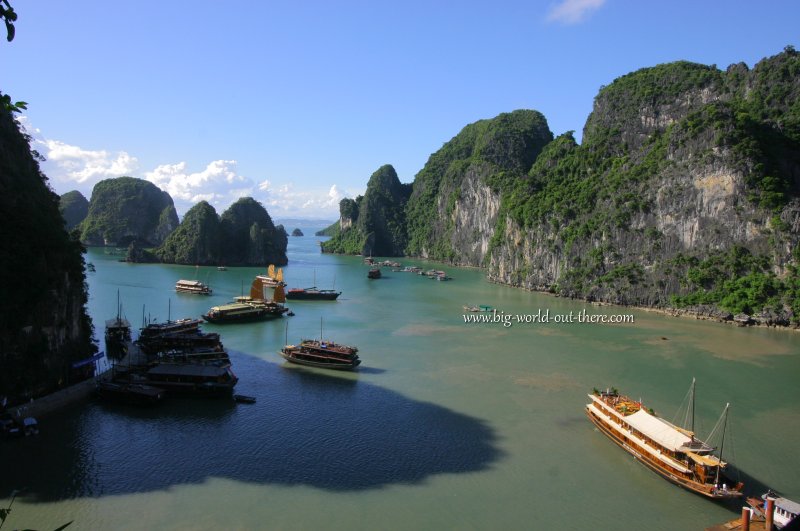
- Halong Bay**
- Bai Chay
- Bo Hon Island
- Cat Ba National Park
- Fighting Cock Island
- Me Cung Cave
- Sung Sot Cave
- Titov Island
- Hoa Lu*
- Den Dinh Tien Hoang Temple
- Den Le Hoan Temple
- Sapa
- Tam Coc*
Streets of Hanoi
- Dao Duy Tu Street
- Gia Ngu Street
- Hang Buom Street
- Hang Trong Street
- Ma May Street
- Ngo Gach Street
- Nguyen Sieu Street
|